


And how GenuinePurity® Trans-Resveratrol can help
Somewhere between the headlines and the hype, resveratrol became one of the most talked-about anti-aging compounds on the planet. A glass of red wine, a plant’s natural defense system, and decades of cutting-edge science all wrapped into a single molecule, no wonder people want to know if it actually works.
The honest answer is: it depends on what form you’re taking, how much of it reaches your cells, and what you’re asking it to do. Here’s a clear-eyed look at what the research really shows, and where GenuinePurity® Trans-Resveratrol fits in.
What Is Resveratrol, and Where Does It Come From?
Resveratrol is a naturally occurring polyphenol compound found in the skin of red grapes, Japanese knotweed (Polygonum cuspidatum), blueberries, peanuts, and a handful of other plants. It’s produced as a stress response, a defense mechanism plants deploy against UV radiation, fungal infection, and environmental injury.
There are two forms: cis-resveratrol and trans-resveratrol. Trans-resveratrol is the biologically active form, the one that researchers use in studies and the one your body can actually use. Most quality supplements are standardized to trans-resveratrol for exactly this reason.
Food sources provide trace amounts. A glass of red wine contains roughly 0.2–2 mg. To approach the doses used in clinical research (typically 150–1,000 mg/day), supplementation is the only practical path.
The Science Behind Resveratrol and Longevity
Interest in resveratrol as a longevity compound was ignited in the early 2000s when researchers discovered it could activate sirtuins, a family of proteins sometimes called “longevity genes.” Sirtuins play a central role in DNA repair, inflammation regulation, metabolism, and cellular stress response. SIRT1, the most studied sirtuin, is directly linked to the same biological pathways activated by caloric restriction, one of the only interventions reliably shown to extend lifespan in animal studies.
Here’s a summary of what peer-reviewed research has found:
Sirtuin Activation and the Caloric Restriction Connection
A landmark 2003 study published in Nature found that resveratrol activated SIRT1 in yeast and extended lifespan. Subsequent research in flies, worms, and mice showed similar effects. While translation to humans is still being studied, the sirtuin pathway remains one of the most compelling mechanisms in longevity science.
Cardiovascular and Metabolic Health
Multiple clinical studies have explored resveratrol’s effects on cardiovascular risk markers. Research published in journals including Nutrients and the American Journal of Clinical Nutrition has shown resveratrol supplementation may:
- Support healthy blood pressure levels already within normal range
- Improve LDL oxidation resistance
- Enhance endothelial function (the health of blood vessel linings)
- Improve insulin sensitivity and glucose metabolism
Inflammation and Oxidative Stress
Chronic low-grade inflammation is one of the key drivers of accelerated aging — sometimes called “inflammaging.” Resveratrol has demonstrated meaningful antioxidant and anti-inflammatory activity in both cell studies and clinical trials, with effects on pathways including NF-κB (a key inflammation regulator) and COX enzymes.
Brain and Cognitive Health
Emerging research suggests resveratrol may support cerebrovascular blood flow and reduce neuroinflammation. A 2017 randomized controlled trial published in Nutrients found that resveratrol supplementation improved memory performance and mood in older adults, with measurable changes in hippocampal connectivity.
The Bioavailability Problem
Here is where most resveratrol supplements fall short. Standard resveratrol has poor oral bioavailability, it’s rapidly metabolized by gut bacteria and liver enzymes before it can reach systemic circulation in meaningful quantities. Research suggests that up to 70–75% of a standard dose may never make it into the bloodstream intact. This is the single biggest limitation of conventional resveratrol supplements, and why delivery technology matters enormously.
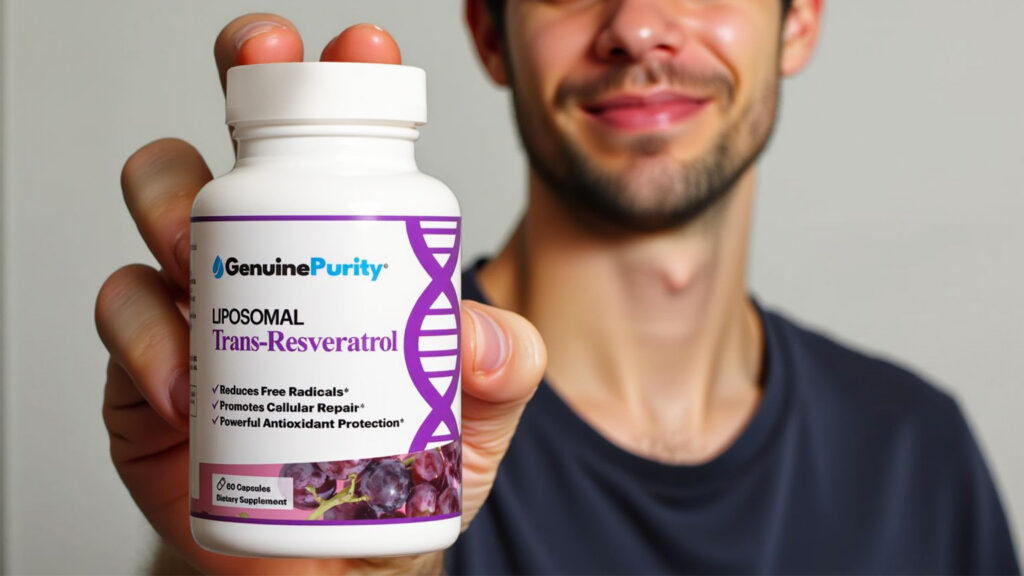
GenuinePurity® Trans-Resveratrol: Built for Absorption
GenuinePurity® Trans-Resveratrol addresses the bioavailability gap directly through liposomal delivery technology, the same delivery system used in pharmaceutical-grade nutrient applications.
What Is Liposomal Delivery?
Liposomes are microscopic phospholipid spheres that encapsulate the active compound, in this case, trans-resveratrol, and protect it from premature breakdown in the gut. Because the phospholipid bilayer mimics the structure of human cell membranes, liposomal nutrients are absorbed more efficiently and delivered more directly into cells.
The result: more resveratrol reaches the bloodstream intact, meaning you need less to achieve the same effect, and your body gets more from every dose.
What Sets GenuinePurity® Apart
- Pure trans-resveratrol, the biologically active form, standardized for potency and consistency
- Liposomal encapsulation for significantly enhanced absorption vs. standard resveratrol supplements
- No fillers, artificial additives, or unnecessary excipients
- Third-party tested for purity and potency
- Manufactured in cGMP-certified facilities
For anyone serious about supporting healthy aging, the form of resveratrol matters as much as the dose. A poorly absorbed supplement may deliver minimal benefit regardless of what’s on the label.
Who Might Benefit Most from Trans-Resveratrol?
Resveratrol is not a drug and is not intended to treat or cure any condition. But based on the existing body of research, it may be a meaningful addition to a healthy lifestyle for:
- Adults over 40 focused on proactive longevity support
- Those with cardiovascular health goals
- Individuals interested in metabolic health and blood sugar management
- Anyone looking to support cognitive function and brain health as they age
- Health-conscious individuals wanting antioxidant support beyond diet alone
As with any supplement, results depend on overall diet, lifestyle, dosing consistency, and individual biology. Resveratrol is best viewed as one component of a broader longevity strategy, not a standalone solution.
The Bottom Line
The research on resveratrol is genuinely promising. It’s one of the few natural compounds with plausible mechanisms touching multiple hallmarks of aging, sirtuin activation, inflammation reduction, oxidative stress defense, and metabolic support. The science is still evolving, but the foundation is solid.
The challenge has always been getting enough of it into the body in a form it can use. That’s exactly what GenuinePurity® Trans-Resveratrol was formulated to solve.
If you’ve been curious about resveratrol but skeptical of products that haven’t lived up to their promise, the difference may not be the compound, it may be the delivery.