

The word “liposomal” is on a lot of supplement labels now. It is on vitamin C, on glutathione, on curcumin, on NAD+ precursors. For most shoppers it registers as a vague signal of quality, something premium, something advanced. Very few people could explain what it actually is or why it would make a difference.
That gap matters, because liposomal delivery is not a marketing invention. It comes from pharmaceutical science, it solves a specific and real problem, and it has decades of published research behind it. It is also, in the supplement aisle, one of the most inconsistently executed technologies on the market. Both things are true at once.
Here is what a liposome is, what problem it was built to solve, when that problem is worth solving, and how to tell whether a product labeled liposomal is delivering on the claim.
The problem: what you swallow is not what you absorb
The most common assumption in supplementation is that the number on the label is the number that reaches your cells. It almost never is.
Between your mouth and the inside of a cell, an ingested compound runs a fairly hostile gauntlet. Stomach acid degrades acid-sensitive molecules. Digestive enzymes break down others. The intestinal wall admits some compounds readily and others reluctantly, and several nutrients rely on specific transporter proteins that saturate, meaning that past a certain dose you simply stop absorbing more regardless of how much you take. Anything that does make it through then passes through the liver, where a portion is metabolized before it ever reaches general circulation.
The result is that bioavailability, the fraction of an ingested dose that actually reaches circulation in an active form, can range from excellent to nearly nothing depending on the compound. Vitamin C is a well studied example. Intestinal absorption is mediated by sodium-dependent vitamin C transporters, and because those transporters saturate, oral dosing hits a ceiling that intravenous administration does not (Davis et al., 2016).
That is the problem liposomes were designed to address. Not potency. Delivery.
What a liposome actually is
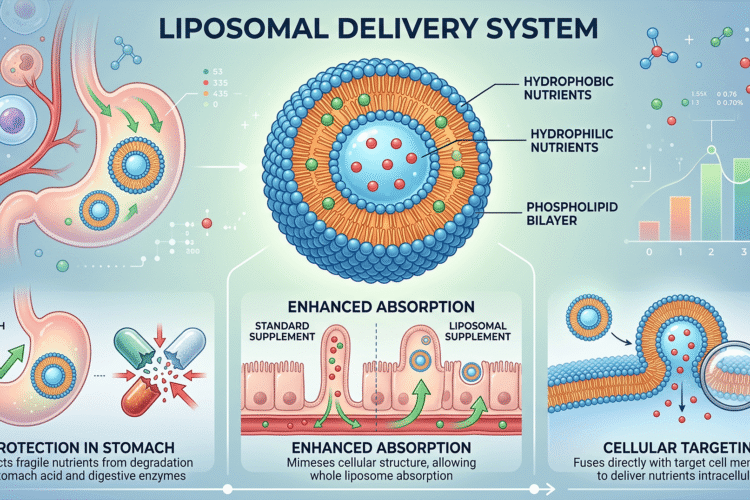
A liposome is a microscopic sphere made of phospholipids, the same class of molecule your own cell membranes are built from. Phospholipids are amphiphilic, meaning one end is attracted to water and the other repels it. Put them in water and they self-assemble into a closed bilayer, a double-walled shell with a watery pocket inside.
That architecture is the whole point. Water-soluble compounds can be carried inside the aqueous core. Fat-soluble compounds can sit within the lipid bilayer itself. Either way the payload is physically shielded from stomach acid and digestive enzymes on its way through the gut. And because the liposome’s outer surface is chemically similar to a cell membrane, it interacts with biological membranes far more readily than a bare molecule does.
This is not a new idea. British hematologist Alec Bangham described these closed phospholipid vesicles in the mid 1960s while studying how phospholipids behave in water (Bangham, Standish and Watkins, 1965). Researchers quickly recognized the delivery potential, and the pharmaceutical industry spent the following decades developing it.
The pharmaceutical track record
Liposomes are the first nanoscale drug delivery system to make the full journey from laboratory concept to routine clinical use.
Doxil, a liposomal formulation of the chemotherapy drug doxorubicin, received FDA approval in 1995 as the first approved nano-drug (Barenholz, 2012). The goal there was not simply to get more drug into the body. It was to change where the drug went and how long it circulated, which reduced the cardiac toxicity that limits conventional doxorubicin. AmBisome, a liposomal antifungal, followed a similar logic. More than a dozen liposomal drug products have since been authorized by the FDA and the European Medicines Agency (Nogueira et al., 2023).
The lipid nanoparticle technology behind the mRNA COVID vaccines is a close relative of the same principle, a lipid shell protecting a fragile payload long enough to reach its destination.
So the underlying science is not in question. The relevant question for a supplement shopper is narrower: does this approach carry over to oral nutrients, and does it carry over for the specific nutrient in the bottle?
What the human evidence shows for oral nutrients
Two human studies are worth knowing, because they are the ones most often cited and because their limitations are as informative as their results.
Vitamin C. Researchers at Colorado State University gave healthy adults 4 grams of vitamin C as an oral placebo, as unencapsulated oral vitamin C, as oral liposomal vitamin C, or intravenously. The liposomal form produced circulating vitamin C concentrations higher than the unencapsulated oral form and lower than intravenous administration (Davis et al., 2016). That is a meaningful middle ground. Oral liposomal delivery did not match an IV drip, but it did clear the ceiling that ordinary oral dosing runs into.
Glutathione. Glutathione is a notoriously difficult oral supplement because the tripeptide is largely broken down during digestion. In a one month pilot study, 12 healthy adults took liposomal glutathione at 500 mg or 1000 mg daily. Glutathione rose in whole blood, red blood cells, plasma and immune cells, with peak increases at two weeks, alongside reductions in oxidative stress markers (Sinha et al., 2018).
Both studies point the same direction. Both are also small, short, and in the glutathione case industry funded and explicitly described by its authors as preliminary. Anyone citing these as proof of a general rule is overreaching. What they reasonably support is the narrower claim that liposomal encapsulation can improve delivery of compounds that are otherwise poorly absorbed orally.
For newer categories such as NAD+ precursors, direct head to head human comparisons of liposomal versus standard forms remain limited and early stage. The mechanism is plausible and consistent with the vitamin C and glutathione work, but the specific evidence base is thinner, and it is more honest to say so than to imply otherwise.
When liposomal delivery matters, and when it does not
Encapsulation adds real manufacturing cost. That cost is worth paying for some compounds and close to pointless for others. The deciding factors are reasonably predictable.
| Liposomal delivery is more likely to matter when | Liposomal delivery adds little when |
| The compound is degraded by stomach acid or digestive enzymes | The compound is already stable through digestion |
| Absorption depends on transporters that saturate at higher doses | Absorption is passive and efficient |
| Oral bioavailability is documented as low or highly variable | Oral bioavailability is already high |
| The compound is expensive per gram, so wasted dose is costly | The compound is cheap enough that a larger dose solves the problem |
| The target is intracellular rather than simply circulating | Circulating levels are the endpoint that matters |
That last row is worth sitting with. Some nutrients are inexpensive and well absorbed, and for those, a bigger dose is a simpler and cheaper answer than a fancier delivery system. Basic magnesium and most fat-soluble vitamins taken alongside a meal fall closer to that category. The case for encapsulation is strongest where the molecule is fragile, the absorption pathway is bottlenecked, or the raw ingredient is costly enough that losing most of the dose to digestion is genuinely wasteful.
The uncomfortable part: not everything labeled liposomal is liposomal
This is where the supplement category diverges sharply from the pharmaceutical one.
Pharmaceutical liposomes are manufactured under strict quality control, with defined critical quality attributes covering particle size, lamellarity, encapsulation efficiency and stability. Even there, regulators have identified characterization of those attributes as one of the hardest parts of development (Kapoor et al., 2017). Dietary supplements face no equivalent requirement, and standardized characterization methods for liposomal supplements remain underdeveloped (Nogueira et al., 2023).
The consequences are documented. Independent analyses of commercial products marketed as liposomal have repeatedly found formulations containing oversized particles, no detectable vesicle structures at all, or simply a mixture of lecithin and active ingredient with no encapsulation. In one widely reported case, a UK advertising regulator ruled against a brand’s liposomal vitamin C marketing because the presence of liposomes had not been substantiated. Analytical work on NAD+ products labeled liposomal has found several with no detectable active ingredient whatsoever.
A phospholipid on the ingredient panel is not proof of a liposome. Sunflower lecithin stirred into a powder is not a liposome. A true liposome requires a closed phospholipid bilayer, and confirming it takes real analytical work: particle size distribution, polydispersity, encapsulation efficiency, and imaging such as cryo-transmission electron microscopy.
How to evaluate a liposomal product
You will rarely get a full characterization report from a supplement company, but the questions themselves are useful filters.
Ask whether the brand will tell you the source and type of phospholipid used. Ask whether the active ingredient purity is verified by a third-party laboratory and whether you can see that documentation. Ask whether the compound in question is one with a documented absorption problem in the first place, because if it is not, the liposomal claim is not buying you much. And be skeptical of any product that leans on the word liposomal while staying vague about everything else.
The honest summary is this. Liposomal delivery is legitimate science with a fifty year track record and a real place in medicine. Whether it matters in a given bottle depends entirely on the compound inside it and on whether the manufacturer actually built what the label claims. Those are two separate questions, and both deserve an answer before you pay a premium.
GenuinePurity® Liposomal Formulas
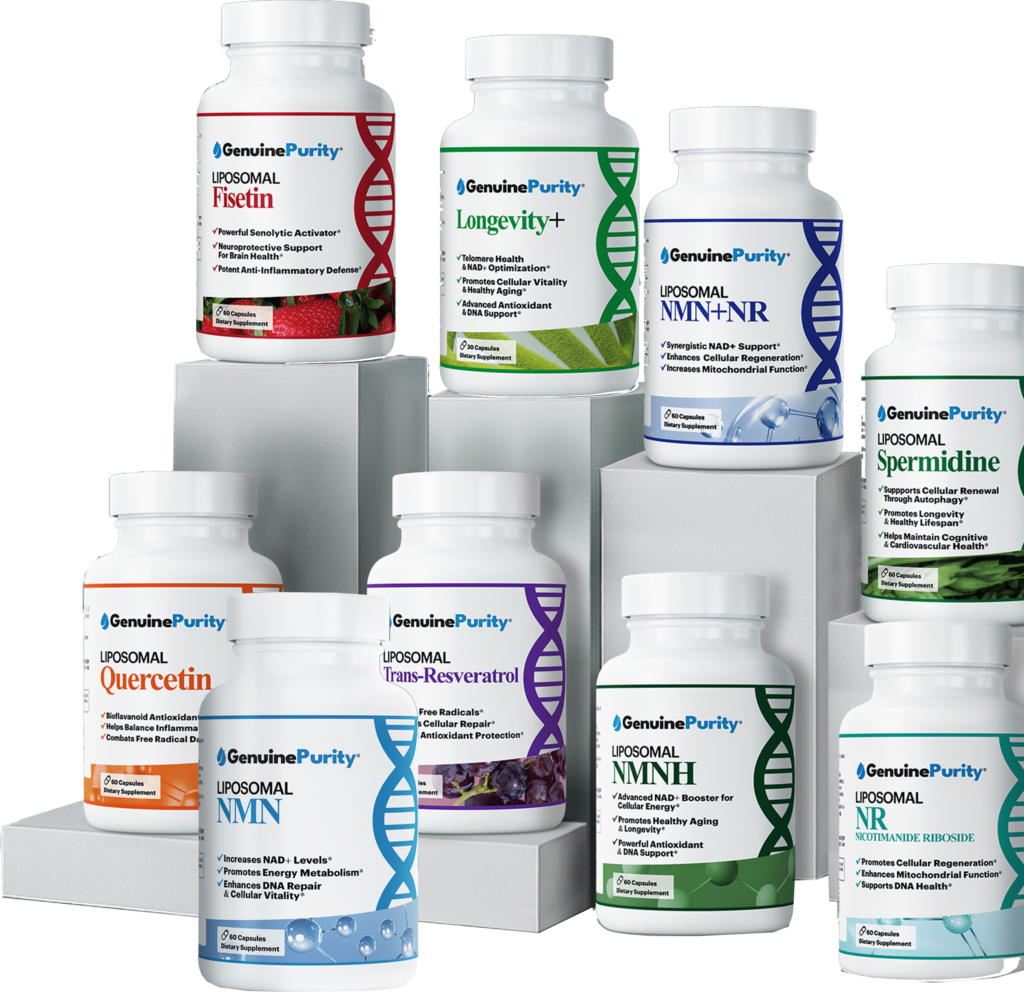
GenuinePurity® builds its longevity range around compounds that sit squarely in the category where delivery is the limiting factor. NAD+ precursors such as NMN, NR and NMNH are exactly the sort of molecule that liposomal encapsulation was developed for, fragile enough to be affected by digestion and expensive enough per gram that poor absorption is a genuine waste. The same logic applies across the rest of the line, which includes Liposomal NMN, Liposomal NMN+NR, Liposomal NMNH, Liposomal NR, Liposomal ALA, Liposomal AKG and Liposomal Apigenin. Each formula uses a phospholipid complex built from non-GMO sunflower lecithin and phosphatidylcholine, and each is produced in cGMP-certified facilities in the United States.
On the verification question, GenuinePurity® Liposomal NMN delivers 250mg of 96% pure β-Nicotinamide Mononucleotide per capsule, and a Certificate of Authenticity confirming that third-party verified purity is available to customers who request it. That is the kind of documentation worth asking any brand for, and the reason it is offered here is that the analytical realities described above are not a secret within the industry. Every GenuinePurity® formula is also covered by a 97-day money-back guarantee, which exists so that the decision to try a formula does not have to be made on marketing language alone. For best absorption, liposomal formulas are generally taken with a meal, since dietary fat supports uptake of the phospholipid carrier.
References
- Bangham, A.D., Standish, M.M., and Watkins, J.C. (1965). Diffusion of univalent ions across the lamellae of swollen phospholipids. Journal of Molecular Biology, 13(1), 238-252. doi:10.1016/S0022-2836(65)80093-6
- Barenholz, Y. (2012). Doxil®, the first FDA-approved nano-drug: lessons learned. Journal of Controlled Release, 160(2), 117-134. doi:10.1016/j.jconrel.2012.03.020
- Allen, T.M., and Cullis, P.R. (2013). Liposomal drug delivery systems: from concept to clinical applications. Advanced Drug Delivery Reviews, 65(1), 36-48.
- Davis, J.L., Paris, H.L., Beals, J.W., Binns, S.E., Giordano, G.R., Scalzo, R.L., Schweder, M.M., Blair, E., and Bell, C. (2016). Liposomal-encapsulated ascorbic acid: influence on vitamin C bioavailability and capacity to protect against ischemia-reperfusion injury. Nutrition and Metabolic Insights, 9, 25-30. doi:10.4137/NMI.S39764
- Sinha, R., Sinha, I., Calcagnotto, A., Trushin, N., Haley, J.S., Schell, T.D., and Richie, J.P. Jr. (2018). Oral supplementation with liposomal glutathione elevates body stores of glutathione and markers of immune function. European Journal of Clinical Nutrition, 72(1), 105-111. doi:10.1038/ejcn.2017.132
- Bozzuto, G., and Molinari, A. (2015). Liposomes as nanomedical devices. International Journal of Nanomedicine, 10, 975-999.
- Kapoor, M., Lee, S.L., and Tyner, K.M. (2017). Liposomal drug product development and quality: current US experience and perspective. The AAPS Journal, 19(3), 632-641.
- Nogueira, S., Rodrigues, M.A., Vilaça, H., and Haas, D. (2023). Liposomes characterization for market approval as pharmaceutical products: analytical methods, guidelines and standardized protocols. Journal of Pharmaceutical and Biomedical Analysis, 236, 115682.