

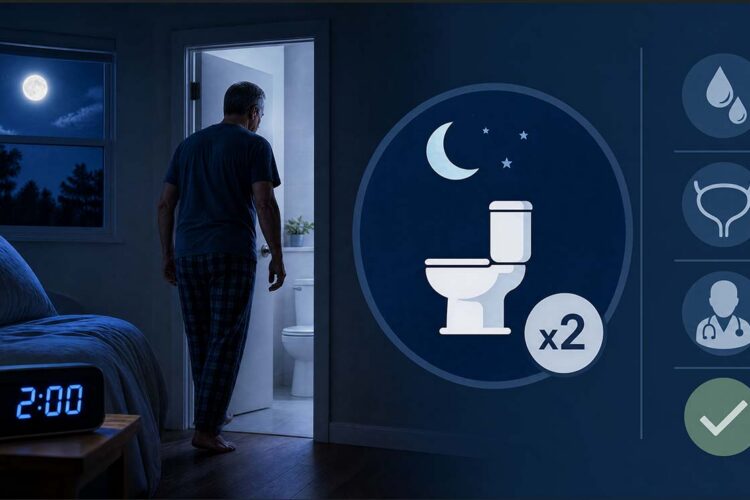
You go to bed tired. You wake at 1 a.m. You wake again at 4 a.m. By the time the alarm goes off, you have technically been in bed for seven hours and you feel like you slept four.
Most men brush this off as part of getting older. And there is some truth in that. But there is a meaningful difference between getting up once and getting up twice, and it is worth understanding which side of that line you are on.
Once is common. Twice is a signal.
Waking up one time in the night to use the bathroom is normal at almost any age. Plenty of people do it for years without any underlying problem at all.
Waking up two or more times, night after night, has a name: nocturia. It is one of the most common urinary complaints in men over 50, and it is also one of the most commonly ignored. Not because it is dangerous on its own, but because it is rarely random. Something is driving it, and that something is usually identifiable.
The good news is that the drivers are often ordinary and fixable. The point of paying attention is not to worry. It is to find out which one applies to you.
What is actually happening
Nighttime bathroom trips come down to three basic mechanisms, and sometimes more than one is in play at once.
Your body is making more urine at night. Normally your kidneys slow production while you sleep. That rhythm can shift with age, with fluid that pools in your legs during the day and gets reabsorbed once you lie down, with certain medications, and with a few cardiovascular and metabolic conditions.
Your bladder is holding less. If the bladder cannot fill completely or cannot empty completely, it signals sooner. In men, prostate changes are a frequent contributor here. As the prostate enlarges with age, it can press on the urethra, which makes the stream weaker and leaves residual volume behind after you go. Less usable capacity means more trips.
Your sleep is breaking on its own. This one surprises people. If something else wakes you first, such as sleep apnea, pain, stress, or alcohol wearing off, you become aware of a bladder that was never full enough to wake you. The bathroom trip is the symptom you notice, not the cause.
Common causes worth knowing about
| Cause | What tends to go with it |
| Age-related prostate enlargement (BPH) | Weak or slow stream, trouble starting, dribbling, feeling of incomplete emptying |
| Evening fluid, alcohol, or caffeine | Symptoms track closely with what and when you drank |
| Fluid pooling in the legs | Ankle or lower leg swelling by evening, relief after lying down |
| Obstructive sleep apnea | Loud snoring, gasping, morning headaches, daytime sleepiness |
| Type 2 diabetes or high blood sugar | Excessive thirst, large urine volumes day and night, fatigue |
| Diuretics or other medications | Onset lines up with a new prescription or a dose change |
| Overactive bladder | Sudden strong urges, day and night, without a weak stream |
| Urinary tract infection | Burning, urgency, cloudy or strong smelling urine, often sudden onset |
Notice how many of these have nothing to do with the prostate. That is exactly why guessing is a poor strategy.
Why it is worth acting on
Sleep that gets cut in half is not the same as sleep that runs straight through. Deep sleep tends to come in the first stretch of the night, and every awakening costs you time getting back into it. Men who get up twice or more consistently report worse daytime energy, worse concentration, and lower mood than men who sleep through, even when total hours in bed look identical.
There is also a practical safety angle. Getting out of bed in the dark, half awake, is one of the more common ways older adults end up falling.
And there is the diagnostic value. Persistent nocturia is sometimes the first noticeable sign of sleep apnea, poorly controlled blood sugar, or a heart or kidney issue that has not announced itself any other way. Chasing it down is worth doing even if the answer turns out to be reassuring.
When to stop managing it yourself and call a doctor
Some symptoms deserve a phone call rather than a lifestyle experiment.
| Talk to a doctor promptly if you notice | Why it matters |
| Blood in the urine | Always needs evaluation, regardless of other symptoms |
| Pain or burning when you urinate | Suggests infection or inflammation |
| Trouble starting, or inability to urinate at all | Possible obstruction, and complete retention is urgent |
| Sudden change over days or weeks | Rapid onset points to a specific trigger, not gradual aging |
| Constant thirst and unusually large urine volumes | Common presentation of high blood sugar |
| Loud snoring with gasping or pauses | Points toward sleep apnea, which is very treatable |
| Leg swelling, shortness of breath, or unexplained weight change | Deserves a cardiovascular and kidney workup |
A useful thing to bring with you: a three day bladder diary. Write down what you drink and when, every bathroom trip with a rough volume, and when you go to bed and wake. It takes almost no effort and it tells a doctor more in one page than twenty minutes of recollection will.
Practical changes to try in the meantime
- Move your fluid intake earlier. Aim to taper roughly two to three hours before bed rather than cutting total intake, which can backfire.
- Cut alcohol in the evening. It suppresses the hormone that concentrates urine overnight, and it fragments sleep on its own.
- Watch caffeine after mid afternoon, including tea, cola, and chocolate.
- If your ankles swell, put your legs up for half an hour in the late afternoon or ask about compression socks. Shifting that fluid before bed rather than after can make a real difference.
- Ask your doctor about diuretic timing. Taking a water pill earlier in the day is often an easy adjustment.
- Try double voiding. Urinate, wait fifteen to thirty seconds, then try again to empty more completely.
- Address the sleep itself. If something other than your bladder is waking you, fixing that fixes the trips.
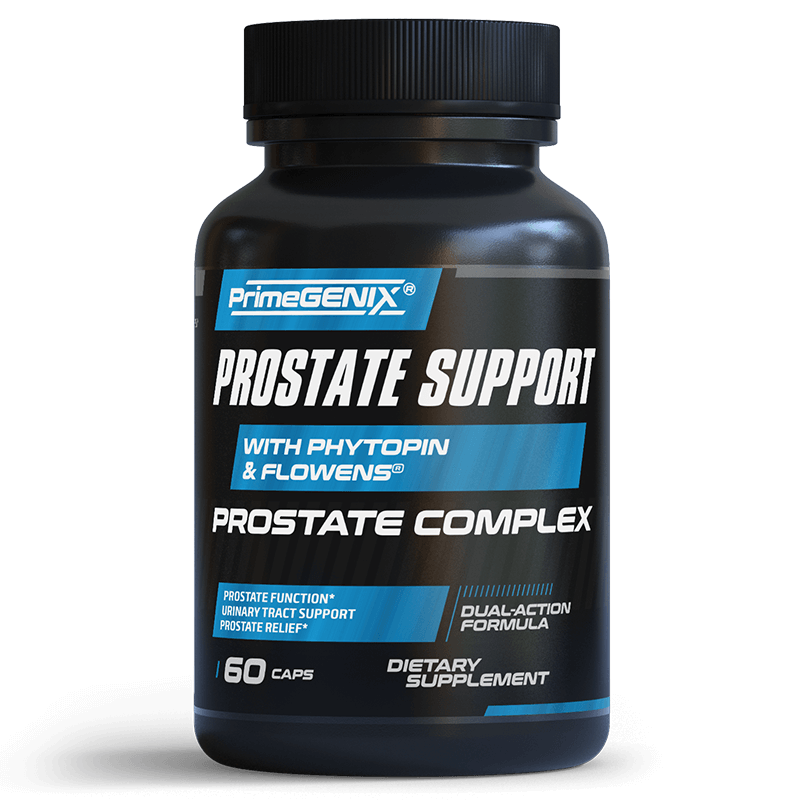
Where PrimeGENIX® Prostate Support fits
If your nighttime trips come with the classic prostate pattern, a weaker stream, hesitation at the start, dribbling at the end, and the sense that you never quite finish, then supporting prostate health is a reasonable part of your long term plan.
PrimeGENIX® Prostate Support is a daily two capsule formula built around four patented, plant sourced ingredients:
| Ingredient | What it is | What it is included for |
| Phytopin® | Standardized pine phytosterol complex | Supports healthy prostate size and normal urinary flow |
| Flowens™ | Cranberry concentrate, 250 mg, the amount used in a six month clinical study | Supports urinary tract comfort and cleanliness |
| Graminex® G63® | Rye pollen extract | Studied in the context of nighttime urinary frequency and urinary comfort |
| LycoRed® Lycopene | Bioavailable tomato derived carotenoid | Antioxidant support for prostate cells |
The formula rounds those out with familiar botanicals including saw palmetto, beta sitosterol, pygeum africanum, and stinging nettle root, plus zinc, selenium, copper, boron, and vitamins D3, E, B2, and B6. The dosing philosophy is straightforward: use the amounts that were actually studied instead of trace amounts added for a label.
Two things worth saying plainly. First, a supplement is support, not a substitute for a diagnosis. If you have not had your prostate evaluated, do that. Second, botanical prostate formulas work gradually. Most men in the clinical literature on these ingredients were assessed at three to six months, not three to six days. Give it a fair run.
PrimeGENIX® Prostate Support is backed by a 67 day money back guarantee, which is roughly the window you would want in order to judge it honestly.
The bottom line
Once a night is ordinary. Twice a night, most nights, is your body flagging something. It might be the beer you had at nine. It might be your prostate. It might be sleep apnea you never suspected. All three are worth knowing about, and none of them get better from being ignored.
Start with a three day bladder diary, make the easy evening adjustments, and get evaluated if the pattern holds or if anything in the red flag list applies to you.