


You drink your water. You might even track it. Yet somewhere in your forties, your knees start announcing themselves on the stairs, your hips feel stiff after a long drive, and getting up from the floor takes a little more negotiation than it used to.
It’s natural to assume that “hydration” means fluid intake. But the hydration that keeps your joints gliding smoothly doesn’t come from the glass on your desk. It depends on a molecule your body makes on its own, one that quietly declines with age: hyaluronic acid.
The Joint Is a Fluid System
Every movable joint in your body, from your knees and hips to your shoulders, elbows, and ankles, is wrapped in a capsule filled with synovial fluid. This fluid has two jobs. It lubricates the cartilage surfaces so bones can glide past each other with minimal friction, and it absorbs and distributes force every time you walk, climb, or lift something heavy. It also carries nutrients to cartilage and helps clear away metabolic waste, which matters because cartilage has no blood supply of its own.
What gives synovial fluid its slick, cushioning texture is hyaluronic acid. Hyaluronic acid is a glycosaminoglycan, a long chain of sugar molecules that attracts and organizes water. It’s often described as holding up to 1,000 times its weight in water. In the joint, it turns what would otherwise be a thin, watery liquid into a viscous, shock-absorbing gel.
That viscosity is the difference between a joint that glides and a joint that grinds.
Why Drinking More Water Doesn’t Fix It
Here’s the part most people miss. Staying well hydrated is important for overall health, but the water content of your joints isn’t simply a function of how much you drink. Water only stays where something holds it. In your joints, skin, and connective tissue, that “something” is hyaluronic acid.
Think of it like a sponge. Pour water over a dense, healthy sponge and it holds on. Pour the same water over a sponge that’s thinning and breaking down, and much of it runs straight through. After 40, the sponge itself is what changes.
What Happens After 40
Research on human knee synovial fluid has found that both the concentration and the molecular size of hyaluronic acid shift with age and with cartilage wear (Temple-Wong et al., 2016). As production slows and breakdown speeds up, the average hyaluronic acid chain becomes shorter, and shorter chains produce thinner, less viscous fluid.
The result is a joint environment with less cushioning and less lubrication. Many people notice it first as stiffness in the morning, a need to “warm up” before activity feels comfortable, or a general sense that their joints are less forgiving than they were a decade ago.
The same decline plays out beyond the joints. Hyaluronic acid is concentrated throughout the extracellular matrix, the structural web of collagen and elastin that gives skin and connective tissue their shape and resilience. That’s why declining hyaluronic acid levels tend to show up in more than one place at once.
What the Research Says About Oral Hyaluronic Acid
For years, many assumed that hyaluronic acid taken by mouth couldn’t do much, since it’s a large molecule that seemed unlikely to survive digestion. Research has made the picture more interesting.
Animal studies using labeled hyaluronic acid found that orally administered hyaluronan was absorbed and distributed to tissues, including joints (Balogh et al., 2008). In human research, a 12-month double-blind, placebo-controlled study of adults with knee discomfort found that those taking oral hyaluronic acid reported greater improvement in symptoms than those taking placebo, particularly among participants under 70 (Tashiro et al., 2012). A separate placebo-controlled pilot trial also reported improvements in comfort and quality of life measures with oral hyaluronic acid (Kalman et al., 2008).
A 2016 review pulling together the human clinical data concluded that oral hyaluronic acid shows promise for supporting knee comfort, while noting that more research is warranted (Oe et al., 2016).
The takeaway is measured but encouraging. Hyaluronic acid taken orally appears capable of reaching the body’s tissues, and supplementing may help support the joint environment that naturally changes with age. How well it’s absorbed, however, remains the central challenge.
The Absorption Problem
Hyaluronic acid is, by nature, a very large molecule. In standard powder form, it has to survive stomach acid and digestive enzymes before it can be absorbed, and a meaningful portion may never make it into circulation. This is where delivery technology matters as much as the ingredient itself.
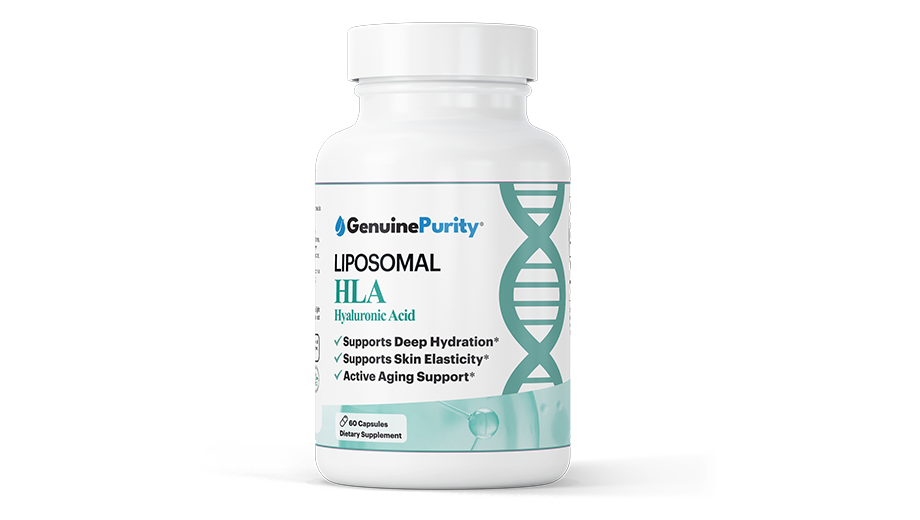
How GenuinePurity® Liposomal HLA Is Different
GenuinePurity® Liposomal HLA was designed specifically around that absorption problem. Each 400 mg dose of hyaluronic acid is encapsulated in liposomes, microscopic spheres made from a phospholipid complex derived from sunflower lecithin.
These tiny lipid bilayers act as a protective shell as the hyaluronic acid passes through the digestive tract, helping shield it from stomach acid and digestive enzymes. Because liposomes are built from the same type of phospholipids that make up your own cell membranes, they’re designed to support absorption into the bloodstream and uptake into tissues, where hyaluronic acid can contribute to hydration at a foundational level.
Here’s how that translates to your joints and beyond:
Joint function. Hyaluronic acid helps preserve the viscosity of synovial fluid, the natural lubricant that reduces friction between cartilage surfaces during movement.
Deep hydration. It promotes healthy water retention within the extracellular matrix, supporting hydration in the tissues that give your body its structure.
Skin elasticity. By keeping the deeper layer of skin well hydrated, hyaluronic acid supports flexibility in collagen and elastin fibers.
Tissue resilience. It contributes to the lubricating and shock-absorbing properties that connective tissues rely on to stay adaptable.
Healthy aging. Daily use helps maintain the body’s hyaluronic acid pools as natural production slows.
Liposomal HLA comes in vegetarian capsules with no unnecessary additives or fillers, is made in cGMP-certified facilities in the United States, and is third-party lab tested. You can review the Certificates of Analysis on the GenuinePurity® website.
How to Take It and What to Expect
The suggested use is 2 capsules daily, taken with a meal. Unlike a topical serum that offers a temporary plumping effect, hyaluronic acid supplementation is designed to work gradually. Supporting your body’s hyaluronic acid pools is a matter of consistency, so it’s best thought of as a daily habit rather than a quick fix.
Liposomal HLA is available as a one-time purchase at $45, or at $29 per bottle with a GenuinePurity® subscription that you can edit, skip, or cancel anytime. Every order is backed by a 97-Day Money Back Guarantee.
Supporting Your Joints From Every Angle
Hyaluronic acid works best as part of a broader approach to joint health. A few habits that pair well with it:
Keep moving. Joint movement helps circulate synovial fluid and deliver nutrients to cartilage. Low-impact activities like walking, cycling, and swimming are especially joint-friendly.
Build strength around your joints. Stronger muscles in the legs and hips help absorb force that would otherwise land on your knees.
Still drink your water. Hyaluronic acid can only hold on to water that’s available, so good fluid intake remains an important partner.
Talk to your healthcare provider. If joint discomfort is persistent, worsening, or accompanied by swelling, it’s worth getting a professional evaluation.
The Bottom Line
The hydration that keeps your joints cushioned isn’t something you can drink your way into. It depends on hyaluronic acid, a molecule your body makes less of every year after 40. Supporting those levels with a well-absorbed form of hyaluronic acid is one practical way to help your joints keep moving the way you want them to.
GenuinePurity® Liposomal HLA delivers 400 mg of hyaluronic acid inside a liposomal delivery system designed to help it reach the tissues that need it most.
References
Balogh L, Polyak A, Mathe D, et al. Absorption, uptake and tissue affinity of high-molecular-weight hyaluronan after oral administration in rats and dogs. Journal of Agricultural and Food Chemistry. 2008;56(22):10582-10593.
Kalman DS, Heimer M, Valdeon A, Schwartz H, Sheldon E. Effect of a natural extract of chicken combs with a high content of hyaluronic acid (Hyal-Joint®) on pain relief and quality of life in subjects with knee osteoarthritis: a pilot randomized double-blind placebo-controlled trial. Nutrition Journal. 2008;7:3.
Oe M, Tashiro T, Yoshida H, et al. Oral hyaluronan relieves knee pain: a review. Nutrition Journal. 2016;15:11.
Tashiro T, Seino S, Sato T, Matsuoka R, Masuda Y, Fukui N. Oral administration of polymer hyaluronic acid alleviates symptoms of knee osteoarthritis: a double-blind, placebo-controlled study over a 12-month period. The Scientific World Journal. 2012;2012:167928.
Temple-Wong MM, Ren S, Quach P, et al. Hyaluronan concentration and size distribution in human knee synovial fluid: variations with age and cartilage degeneration. Arthritis Research & Therapy. 2016;18:18.
These statements have not been evaluated by the Food and Drug Administration. This product is not intended to diagnose, treat, cure, or prevent any disease.