


It usually starts quietly. A faint buzz in your toes when you climb into bed. Fingertips that feel slightly “asleep” while you scroll your phone, even though you haven’t been leaning on them. A pins-and-needles sensation that fades before you really think about it.
Most people shrug it off. Maybe you sat wrong. Maybe your shoes are too tight. And sometimes that really is all it is.
But when tingling in the hands and feet keeps coming back, it deserves a closer look. Your nerves are some of the hardest-working, most energy-hungry cells in your body, and that subtle sensation can be one of the earliest ways they tell you they’re under strain.
What That Tingling Actually Is
The medical term for tingling, prickling, or “pins and needles” is paresthesia. It happens when the signals traveling along your nerves get disrupted, misfire, or slow down.
Occasional, temporary paresthesia is completely normal. Cross your legs for too long and you compress a nerve and restrict blood flow. Stand up, and within a minute the feeling returns.
Recurring tingling with no obvious cause is different. It often points to the peripheral nervous system, the vast network of nerves that carries messages between your brain, spinal cord, and the rest of your body.
Why Hands and Feet Feel It First
There’s a reason these symptoms tend to appear in the toes and fingertips before anywhere else. The nerves that reach your feet are the longest in your body, stretching roughly a metre from the base of your spine. Longer nerves have more surface area exposed to stress and a longer supply line for nutrients and energy.
Think of it like the far end of a garden hose. When water pressure drops, the end of the hose is where you notice it first. When nerves are under pressure, the extremities are where you feel it first. This is why nerve-related tingling often follows a “stocking and glove” pattern, starting in the feet and later appearing in the hands.
Why Nerves Are So Vulnerable
Nerve cells have a demanding job. They fire electrical signals constantly, and every signal costs energy. That energy comes from your mitochondria, the tiny power plants inside each cell.
Here’s the catch: producing energy also generates reactive oxygen species (free radicals) as a byproduct. When free radical production outpaces your body’s antioxidant defenses, you get oxidative stress. Because nerve cells are so metabolically active and rich in delicate fatty membranes, they’re especially sensitive to this kind of damage.
Several everyday factors can tip the balance:
Blood sugar. When glucose stays elevated, excess sugar can bind to proteins and form Advanced Glycation End-products (AGEs), which stiffen tissues and increase oxidative stress. High blood sugar is one of the most common contributors to peripheral nerve problems.
Circulation. Nerves depend on tiny blood vessels for oxygen and nutrients. When microcirculation suffers, the nerves at the end of the line feel it.
Nutrient gaps. Nerves rely on nutrients like vitamin B12 to maintain their protective myelin coating.
Common Contributors to Tingling Hands and Feet
| Contributor | How It Affects Nerves |
| Elevated blood sugar | Increases oxidative stress and glycation that can damage nerve fibres over time |
| Vitamin B12 deficiency | Weakens the myelin sheath that insulates nerves |
| Nerve compression | Pressure from repetitive motion or posture (for example, carpal tunnel) disrupts signalling |
| Alcohol | Can be directly toxic to nerves and depletes key B vitamins |
| Thyroid imbalance | Low thyroid function can cause fluid retention that presses on nerves |
| Certain medications | Some prescriptions list nerve-related tingling as a side effect |
| Reduced circulation | Limits oxygen and nutrient delivery to the extremities |
When to Talk to Your Doctor
Persistent tingling is worth mentioning at your next appointment, especially if it’s spreading, getting worse, or accompanied by numbness, burning, weakness, or balance problems. Simple blood work can check for common causes like blood sugar changes, B12 levels, and thyroid function.
Seek medical care immediately if tingling comes on suddenly, affects one side of your body, or appears with facial drooping, confusion, trouble speaking, or weakness. These can be signs of a medical emergency.
Everyday Habits That Support Healthy Nerves
The good news is that nerves respond well to consistent care. A few habits make a real difference over time:
Keep blood sugar steady. Pair carbohydrates with protein, fibre, and healthy fats, and limit refined sugars.
Move daily. Walking and gentle activity improve circulation to your hands and feet.
Mind your B vitamins. Eggs, fish, dairy, and leafy greens support nerve-friendly nutrition.
Moderate alcohol. Less is better for your nerves.
Check your feet. Especially if you have reduced sensation, a quick daily look helps catch small issues early.
Support your antioxidant defenses. Since oxidative stress is central to nerve strain, giving your body the right antioxidant tools matters.
Where Alpha Lipoic Acid Fits In
This is where Alpha Lipoic Acid (ALA) comes in. ALA is a naturally occurring compound your body makes in small amounts, and it plays several roles that line up directly with what nerves need.
It works everywhere. Most antioxidants are either water-soluble or fat-soluble. ALA is both, which is why researchers have called it the “universal antioxidant.” That allows it to protect both the watery interior of cells and the fatty membranes that surround nerve fibres.
It recharges other antioxidants. Once ALA neutralizes a free radical, it converts into its reduced form, dihydrolipoic acid (DHLA), which helps regenerate vitamin C, vitamin E, and glutathione. Glutathione is especially important in nerve tissue, where it helps maintain redox balance and clear metabolic waste.
It powers mitochondria. ALA serves as a cofactor for key mitochondrial enzymes involved in energy production, supporting the constant energy supply that nerve cells demand.
It supports healthy glucose metabolism. ALA supports insulin signalling and the activity of glucose transporters like GLUT4, helping move sugar from the bloodstream into cells where it can be used. Healthy glucose utilization helps limit the formation of AGEs.
ALA has also been studied specifically for nerve health. In the SYDNEY 2 trial, adults with blood-sugar-related nerve discomfort who took 600 mg of oral ALA daily for five weeks reported meaningful improvements in symptoms like burning, prickling, and numbness compared with placebo. A four-year trial (NATHAN 1) found ALA was well tolerated over long-term use and noted improvements in some measures of nerve function. A 2012 meta-analysis of randomized trials also concluded that ALA supports symptom improvement in this population.
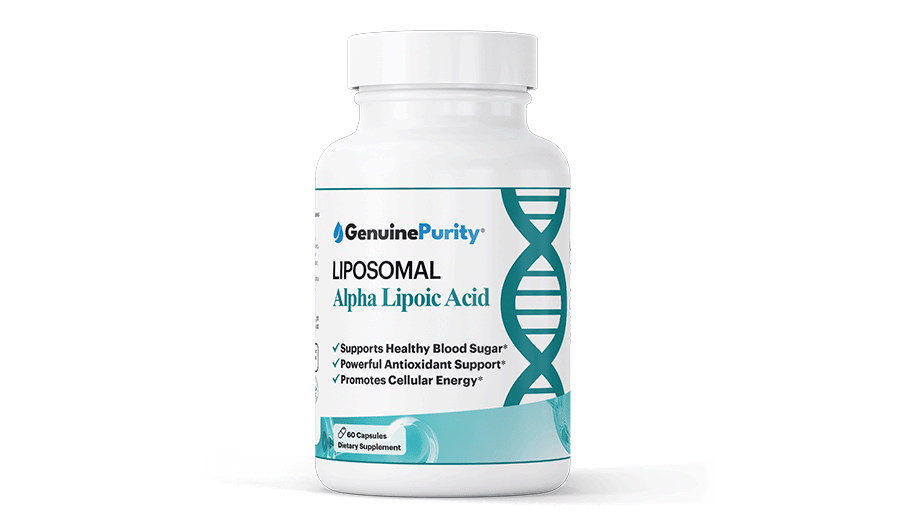
GenuinePurity® Liposomal Alpha Lipoic Acid
The challenge with standard ALA is that it’s relatively unstable and prone to breaking down in the harsh environment of the digestive tract, which can limit how much actually reaches your cells.
GenuinePurity® Liposomal Alpha Lipoic Acid was designed to address that. Each serving delivers 600 mg of Alpha Lipoic Acid, the same amount used in key nerve health research, wrapped in liposomes made from sunflower lecithin phospholipids. These tiny protective spheres mimic the structure of your own cell membranes, helping shield ALA through digestion and carry it into the bloodstream and into cells.
Every batch is third-party tested and made in the USA in cGMP-certified facilities, and each bottle is backed by a 97-day money-back guarantee.
For broader antioxidant support, ALA pairs naturally with GenuinePurity® Liposomal Vitamin C (1,350 mg per serving), since ALA helps regenerate spent vitamin C and keep your antioxidant network active.
Take GenuinePurity® Liposomal Alpha Lipoic Acid daily with food. Because ALA supports healthy glucose uptake, speak with your healthcare provider before starting if you take medication for blood sugar, have a thyroid condition, or are pregnant or nursing.
Listen to the Signal
Tingling in your hands and feet isn’t something to panic about, but it isn’t something to ignore either. It’s often an early message from nerves that are working hard and could use more support.
Get it checked, build steady daily habits, and give your nerves the antioxidant and energy support they rely on. Your extremities are telling you something. It’s worth listening.
Explore GenuinePurity® Liposomal Alpha Lipoic Acid
References
- Packer L, Witt EH, Tritschler HJ. Alpha-lipoic acid as a biological antioxidant. Free Radical Biology and Medicine. 1995;19(2):227-250.
- Ziegler D, et al. Oral treatment with alpha-lipoic acid improves symptomatic diabetic polyneuropathy: the SYDNEY 2 trial. Diabetes Care. 2006;29(11):2365-2370.
- Ziegler D, et al. Efficacy and safety of antioxidant treatment with α-lipoic acid over 4 years in diabetic polyneuropathy: the NATHAN 1 trial. Diabetes Care. 2011;34(9):2054-2060.
- Mijnhout GS, et al. Alpha lipoic acid for symptomatic peripheral neuropathy in patients with diabetes: a meta-analysis of randomized controlled trials. International Journal of Endocrinology. 2012;2012:456279.
These statements have not been evaluated by the Food and Drug Administration. This product is not intended to diagnose, treat, cure, or prevent any disease.