


Walk down any supplement aisle and you’ll see green tea extract labeled as a “fat burner,” a “thermogenic,” or a “metabolism booster.” There is real science behind those labels. But the real effect is smaller and more conditional than the marketing suggests. It is also more interesting.
This article covers what the research measured, how the mechanism works, where the marketing goes too far, and how to use green tea extract so your expectations match what it can do.
What “Boosting Metabolism” Actually Means
Your metabolic rate is the total energy your body uses in a day. It has three parts. The largest is resting metabolic rate, the energy you burn just keeping your organs running. The second is the thermic effect of food, the energy spent digesting. The third is movement.
No supplement meaningfully rebuilds that foundation. What a compound can do is nudge two smaller variables:
- Thermogenesis: how much extra heat, and therefore energy, your body produces.
- Fuel selection: whether your body leans on fat or carbohydrate for that energy. Researchers call this fat oxidation.
These are two different outcomes. Burning more fat as fuel does not automatically mean burning more total calories, and the reverse is also true. Most green tea marketing blurs the two together.
The Mechanism: Why EGCG and Caffeine Work as a Pair
Your body uses a signaling molecule called norepinephrine to tell fat cells to release stored energy and to increase heat production. Once that signal is sent, an enzyme called catechol-O-methyltransferase (COMT) breaks the norepinephrine down.
EGCG (epigallocatechin-3-gallate), the most abundant catechin in green tea, appears to slow COMT in laboratory research. That lets the norepinephrine signal last longer. Caffeine works at a different point in the same pathway. It slows the breakdown of a downstream messenger inside the cell.
The two compounds release two different brakes on the same system, which is why the research consistently points to the combination rather than either one alone. The prevailing view is that green tea catechins act on sympathetic nervous system activity, raising energy expenditure and encouraging fat oxidation.¹
One of the earliest human studies made this point directly. Researchers found that the extract’s effects on thermogenesis and fat oxidation couldn’t be explained by caffeine alone, since a matching dose of caffeine by itself failed to change energy expenditure or fuel use.²
What the Research Actually Shows
The strongest evidence comes from respiration chamber studies. In these studies people spend 24 hours in a sealed room that measures every breath, so energy use is measured directly rather than estimated.
A 2011 meta-analysis pooled these studies. It found that catechin-caffeine mixtures and caffeine alone both significantly increased energy expenditure, but only the catechin-caffeine combination also increased fat oxidation compared with placebo.³ The size of the fat oxidation effect was meaningful: 24-hour fat oxidation rose roughly 12 to 16 percent with the catechin-caffeine mixtures.³
The calorie effect was more modest. The same analysis found that these supplements raised daily energy expenditure in a dose-dependent way, by about 0.4 to 0.5 kJ for each milligram taken.³ In everyday terms, estimates from the best-case studies are commonly put near 100 calories a day, and often less.
The effect also holds up in older adults, although it is smaller. A 2019 trial in middle-aged adults found that two weeks of tea catechins with caffeine raised resting energy expenditure after intake by 1.7 percent, which the authors considered relevant to age-related weight gain.⁴
Where the Marketing Overreaches
| Marketing claim | What the research supports |
| “Melts fat” | A measurable shift toward using fat as fuel, seen mostly in short-term, tightly controlled studies³ |
| “Burns hundreds of extra calories” | Roughly 100 calories a day in the best-case studies, often less³ |
| “Works the same for everyone” | Results vary with habitual caffeine intake, and researchers have studied whether COMT genetics change the response⁵˒⁶ |
| “Guaranteed weight loss” | Long-term weight results are small and inconsistent across trials⁵˒⁷˒⁸ |
| “More is better” | Higher supplemental doses raise liver safety concerns⁹ |
The long-term weight data deserves an honest look. Earlier meta-analyses found small average weight losses over about 12 weeks,⁵ and a Cochrane review judged the effect small and unlikely to be clinically important.⁷ A longer Maastricht trial found that long-term green tea extract supplementation did not change fat absorption, resting energy expenditure, or body composition in adults.⁸
The takeaway is not that green tea extract “doesn’t work.” Its metabolic effect is real but modest, and it will not replace the effect of food choices, sleep, and movement.
The Safety Line That Actually Matters
Quality and dose matter more with green tea extract than with most botanicals. In 2018, the European Food Safety Authority reviewed the evidence and concluded that clinical trials showed EGCG intakes at or above 800 mg per day from supplements caused a statistically significant increase in liver enzymes compared with controls.⁹ The same review found no evidence of liver harm below 800 mg EGCG per day for up to 12 months.⁹
In practice, this means you should know exactly how much EGCG your supplement delivers. Stay well below that threshold, and take green tea extract with food. If you have a liver condition, take medication, or are pregnant, check with your healthcare provider first.
So Is Green Tea Extract Worth Taking?
Yes, if you take it for the right reasons.
Green tea catechins are some of the most researched plant antioxidants available. They help cells manage oxidative stress, support healthy inflammatory responses, and support mitochondrial function. The metabolic nudge is a genuine bonus on top of that foundation, and it is most useful alongside regular activity. Research on green tea extract taken before moderate exercise has reported higher fat use during the session.¹⁰
If you want a pill that does the work of diet and exercise, green tea extract will disappoint you. If you want well-studied antioxidant support with a small, measurable push toward metabolic efficiency, it’s one of the more credible options on the shelf.
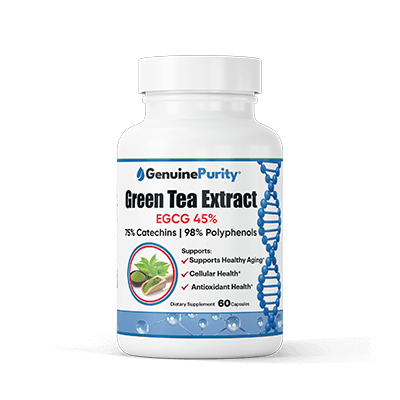
How GenuinePurity® Green Tea Extract Fits
GenuinePurity® Green Tea Extract was built around the details that matter in the research: standardization, a transparent EGCG content, and a sensible dose.
Each capsule delivers 500 mg of green tea extract standardized for 98% polyphenols, 75% catechins, and 45% EGCG.¹¹ That works out to about 225 mg of EGCG per capsule. At the maximum label dose of two capsules, you get about 450 mg a day, comfortably below the 800 mg threshold identified by EFSA.⁹ Standardization matters because catechin levels in green tea leaves vary widely from plant to plant, so an unstandardized extract can deliver very different amounts from one bottle to the next.
The formula keeps only minimal, naturally occurring caffeine, and this is a deliberate choice.¹¹ It is not designed as a high-stimulant fat burner. It is designed to deliver green tea’s antioxidant compounds without jitters or a crash. If you already drink green tea or coffee in the morning, you’re getting the caffeine half of the pairing the research studied.
Directions are simple: take 1 capsule once or twice daily with food.¹¹ Each batch is verified by third-party laboratories, with a Certificate of Analysis available, and the formula is made in cGMP-certified facilities in the United States. It is also backed by a 97-day money-back guarantee.¹¹
The honest pitch is this: GenuinePurity® Green Tea Extract gives you the compounds behind green tea’s best research, in known amounts, at a dose that respects the safety data. Pair it with movement, and let it support the work you’re already doing.
These statements have not been evaluated by the Food and Drug Administration. This product is not intended to diagnose, treat, cure, or prevent any disease.
References
- Rondanelli M, et al. Effect of acute and chronic dietary supplementation with green tea catechins on resting metabolic rate, energy expenditure and respiratory quotient: a systematic review. Nutrients. 2021;13(2):644.
- Dulloo AG, et al. Efficacy of a green tea extract rich in catechin polyphenols and caffeine in increasing 24-h energy expenditure and fat oxidation in humans. Am J Clin Nutr. 1999.
- Hursel R, et al. The effects of catechin rich teas and caffeine on energy expenditure and fat oxidation: a meta-analysis. Obes Rev. 2011;12(7):e573-81.
- Effect of tea catechins with caffeine on energy expenditure in middle-aged men and women: a randomized, double-blind, placebo-controlled, crossover trial. Eur J Nutr. 2019.
- Hursel R, Viechtbauer W, Westerterp-Plantenga MS. The effects of green tea on weight loss and weight maintenance: a meta-analysis. Int J Obes. 2009;33(9):956-61.
- Hursel R, Janssens PL, Bouwman FG, Mariman EC, Westerterp-Plantenga MS. The role of catechol-O-methyl transferase Val(108/158)Met polymorphism (rs4680) in the effect of green tea on resting energy expenditure and fat oxidation: a pilot study. 2014.
- Jurgens TM, et al. Green tea for weight loss and weight maintenance in overweight or obese adults. Cochrane Database Syst Rev. 2012.
- Janssens PL, Hursel R, Westerterp-Plantenga MS. Long-term green tea extract supplementation does not affect fat absorption, resting energy expenditure, and body composition in adults. J Nutr. 2015;145(5):864-70.
- EFSA ANS Panel. Scientific opinion on the safety of green tea catechins. EFSA Journal. 2018;16(4):5239.
- Venables MC, Hulston CJ, Cox HR, Jeukendrup AE. Green tea extract ingestion, fat oxidation, and glucose tolerance in healthy humans. Am J Clin Nutr. 2008;87(3):778-84.
- GenuinePurity® Green Tea Extract product information. genuinepurity.com/products/green-tea-extract