


What do the world’s longest-living populations have in common — and what can we learn from them?
What if the Secret to a Long Life Isn’t a Secret at All?
Somewhere in a mountain village in Sardinia, a shepherd in his nineties is walking steep terrain between his home and his flock. Across the Pacific, a group of elderly Okinawan women are gathering — as they have every day for nearly a century — to share food, stories, and laughter. In a quiet California city, a community of Seventh-day Adventists is sitting down to a plant-rich meal before an evening walk.
None of them are following a biohacking protocol. None of them count macros or attend cryotherapy sessions. And yet, they are among the longest-lived people on Earth.
What these populations share — and what decades of rigorous demographic research has begun to map — is not luck, genetics, or a single superfood. It is a way of life. A constellation of daily habits, social structures, and environmental conditions that together create the conditions for extraordinary longevity and, crucially, exceptional health well into old age.
“The most powerful longevity medicine isn’t a supplement or a diet plan — it’s a way of life.” — Ridgecrest Regional Hospital, 2026
The Blue Zones: Five Windows Into Long Life
The concept of “Blue Zones” was introduced in the early 2000s by longevity researcher and National Geographic Fellow Dan Buettner, working alongside a team of demographers, epidemiologists, and anthropologists. They set out to identify geographic pockets where populations exhibited unusually high concentrations of centenarians and statistically low rates of chronic disease.
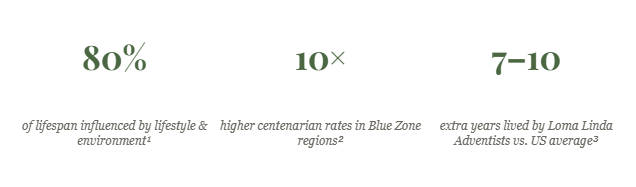
Using epidemiological data, civil birth and death records, church archives, genealogical records, and in-person interviews, five regions were identified and validated. These areas were dubbed Blue Zones, where people reach age 100 at ten times greater rates than in the United States.⁴
Okinawa, Japan
Home to the world’s longest-lived women. Famous for the daily “ikigai” philosophy and the “hara hachi bu” practice of eating to 80% fullness. The Okinawan moai social network — groups formed in childhood and maintained for life — provides deep emotional and financial security.
Sardinia, Italy (Nuoro Province)
Concentrated in mountain villages, Sardinia is unique in its exceptionally high proportion of male centenarians. Research found a 69% greater likelihood of longevity among shepherds whose daily terrain demanded natural, sustained physical activity.⁵
Ikaria, Greece
On this Aegean island, people regularly live into their late 90s with low rates of dementia and heart disease. A Mediterranean diet rich in legumes, olive oil, and herbs, combined with afternoon naps and strong community bonds, defines daily life.
Nicoya Peninsula, Costa Rica
Nicoyan elders embrace “plan de vida” — a reason to live. A traditional diet of beans, corn, squash, and tropical fruit, calcium-rich water, and tight family bonds contribute to their remarkable longevity among men born before 1930.⁶
Loma Linda, California
The only urban Blue Zone. The Seventh-day Adventist community here outlives the average American by 7 to 10 years, attributable to plant-based diets, regular Sabbath rest, abstinence from tobacco and alcohol, and a strong sense of shared purpose.³
Note: A 2025 peer-reviewed paper in The Gerontologist confirmed that ages in the original Blue Zones have been rigorously validated using multiple independent documentary sources, directly addressing recent critiques of the methodology.⁷
The Power 9: What All Blue Zones Share
After years of field research, Buettner’s team distilled nine evidence-based lifestyle factors common to all five regions. These are known as the “Power 9.”
1. Move naturally
2. Purpose (Ikigai / Plan de Vida)
Having a clear reason to get up in the morning is one of the most statistically significant predictors of longevity found across all five zones. Okinawans call it “ikigai”; Nicoyans call it “plan de vida.”
3. Downshift
Chronic stress accelerates cellular aging. All Blue Zone populations have built-in, culturally embedded stress relief — prayer, napping, ancestor veneration, or simply the slower pace of village life.
4. The 80% rule (Hara Hachi Bu)
Okinawans stop eating when they feel 80% full. Studies suggest this mild, habitual caloric restriction — combined with eating slowly — prevents overeating and supports metabolic health over a lifetime.⁸
5. Plant-based diet
Across all Blue Zones, the diet is approximately 95% plant-based. Beans, lentils, greens, whole grains, and nuts form the foundation. Meat is consumed infrequently — typically five or fewer times per month.⁸
6. Wine at 5 (moderate, social alcohol)
Most Blue Zone populations — except Seventh-day Adventists — consume 1–2 glasses of wine daily, usually with friends or food. The social context appears to amplify any cardiovascular benefits.
7. Belong (faith community)
Attending faith-based services even a few times per month is associated with added years of life expectancy across all Blue Zone communities, regardless of denomination.
8. Loved ones first
Centenarians in all Blue Zones prioritise family. They keep ageing parents nearby, commit deeply to a life partner, and invest heavily in their children — practices that reduce social isolation and stress.
9. Right tribe (social circles)
Okinawa’s moai — social groups formed in childhood and maintained for life — demonstrate the power of long-term community. Research consistently shows that social connectivity is among the strongest predictors of longevity.⁹
What Science Tells Us About Genes vs. Lifestyle
A foundational study — the Danish Twin Study — established that only about 20% of how long the average person lives is dictated by genetics, while the other 80% is shaped by lifestyle and environment.¹ This finding has been supported by research from the National Institutes of Health, which similarly estimates that genetics accounts for just 20–30% of longevity.⁸
The implication is profoundly hopeful: most of us have far more agency over our lifespan than we realise. The habits practiced daily in Blue Zone communities — many of them simple, low-cost, and accessible — represent a blueprint that anyone can begin to apply.
“No single food, supplement, or intervention explains these communities’ health. What explains it is an entire ecosystem of habits.” — Ridgecrest Regional Hospital, 2026
The Threat of Modernisation
Blue Zones are not permanent. The story of Okinawa is sobering: once home to the world’s longest-lived people, the population no longer meets Blue Zone criteria. The adoption of Western dietary patterns following World War II, combined with urbanisation, eroded the very lifestyle factors that had produced such remarkable longevity. Life expectancy in Okinawa — once the highest in Japan — has declined measurably over recent decades.⁶
Similarly, younger generations in Sardinia and Nicoya are increasingly abandoning traditional diets and community structures in favour of Western patterns. As a 2024 review noted, modernisation, westernisation, and immigration can dilute or destroy the conditions that make a Blue Zone.⁶
The lesson is clear: longevity is not inherited passively. It is created — actively, daily, collectively.
Can We Build Blue Zones Anywhere?
Dan Buettner’s Blue Zones Project has attempted to answer this question directly, working with policymakers, schools, local businesses, and individuals across communities in the United States to create environments where the healthy choice is also the easy choice. Early results suggest that community-level interventions can meaningfully shift health outcomes — reducing obesity, increasing physical activity, and extending life expectancy.
A 2023 PwC report noted that community-based health programmes could reduce chronic disease prevalence by 20% in developed nations, while a 2024 Lancet study suggested that scaling such policies globally could add three to five years to global life expectancy by 2050.²
You don’t need to move to Sardinia. But understanding why people there live so long — and borrowing even a few of their habits — may be one of the most evidence-based investments you can make in your own future.

GenuinePurity® Longevity+
The lifestyle habits of Blue Zone communities tell a powerful story about what the human body is capable of given the right conditions. But even the most dedicated efforts to eat well, move naturally, and manage stress can leave cellular-level gaps — particularly as we age and our bodies’ natural production of key longevity-supporting molecules declines. That’s where science-backed supplementation can play a meaningful complementary role.
GenuinePurity® Longevity+, developed by Leading Edge Health, is a 100% natural daily supplement formulated specifically to support healthy aging at the cellular level. Its formula brings together five scientifically studied anti-aging nutrients — each selected for its relevance to the same biological mechanisms that underpin longevity research: NAD+ production, mitochondrial energy, telomere maintenance, antioxidant defence, and gene signalling. Together, these five compounds operate synergistically to address what researchers now call the “hallmarks of aging.”
What makes Longevity+ particularly notable is its advanced enteric coating system, which protects each nutrient from degradation in the stomach and ensures optimal absorption in the gut — a critical distinction, since even the most potent ingredients are only as effective as the body’s ability to absorb and utilizse them. All formulations are manufactured in FDA-registered facilities and undergo rigorous third-party testing.
Think of Longevity+ as the cellular counterpart to the lifestyle habits of the world’s longest-lived populations. You cultivate the habits; Longevity+ helps support the underlying biology. Together, they form a more complete approach to a longer, healthier healthspan. Backed by a 97-day risk-free guarantee, there’s never been a better time to take your first step toward your own longevity blueprint.
References
- Herskind AM et al. (1996). The heritability of human longevity: a population-based study of 2872 Danish twin pairs. Human Genetics. Cited in: Buettner D & Skemp S. (2016). Blue Zones. American Journal of Lifestyle Medicine. PMC6125071.
- StatRanker / WHO Analysis (2025). Blue Zones: What We Can Learn from the Longest-Living Populations. statranker.org
- Centers for Disease Control and Prevention (CDC). Life expectancy data 2022. Cited via StatRanker Blue Zones Analysis, 2025.
- Buettner D & Skemp S. (2016). Blue Zones: Lessons From the World’s Longest Lived. American Journal of Lifestyle Medicine. PMC6125071.
- Mulla S. (2024). A Systematic Review: Longevity and Quality of Life in Blue Zones. Theses and Graduate Projects, Augsburg University. Idun repository.
- Austad SN & Pes GM. (2025). The validity of Blue Zones demography: a response to critiques. The Gerontologist. PMC12709677.
- American Federation for Aging Research (AFAR) / EurekAlert press release. (December 17, 2025). Scientific validity of blue zones longevity research confirmed.
- Robertson R, PhD. (Updated December 3, 2024). Why People in “Blue Zones” Live Longer Than the Rest of the World. Healthline. Medically reviewed by Goodwin M, MD.
- Harvard Study of Adult Development. Social connection and longevity data cited in: Mulla S. (2024). Idun repository, Augsburg University.
- University of Florida College of Medicine (2024). The Secrets Behind Blue Zones: Why People Are Living Longer. online.aging.ufl.edu
- GenuinePurity® / Leading Edge Health (2025–2026). Longevity+ product information. leadingedgehealth.com