


The skin beneath your eyes is among the most delicate on the entire body — approximately 40% thinner than skin elsewhere on the face. This anatomical reality makes the under-eye zone one of the first places where aging becomes visible. Dark circles, hollowness, puffiness, and fine lines can emerge as early as one’s late twenties, causing many people to look older or more fatigued than they actually feel.
While the beauty industry offers no shortage of miracle claims, the science of under-eye aging is nuanced. Understanding what actually causes these concerns — and what has been clinically shown to help — is the first step toward choosing effective solutions. This article breaks down the biology of under-eye aging and reviews the most evidence-supported treatments available today.
Understanding the Under-Eye Area
The periorbital zone (the area around the eyes) has several features that make it uniquely susceptible to early aging:
- •
- Thin skin: The under-eye dermis contains fewer collagen and elastin fibers than other facial regions, making it quick to show structural changes.
- Limited sebaceous glands: Without the oil production found elsewhere, this area is more prone to dryness and crepe-like texture.
- Prominent vasculature: Blood vessels sit close to the surface here, contributing to dark discoloration when they dilate or when blood pools.
- Fat compartments: Orbital fat pads can shift downward or herniate with age, producing puffiness and shadowing.
- Frequent movement: The orbicularis oculi muscle contracts thousands of times per day during blinking and expression, accelerating the formation of dynamic wrinkles.
According to a 2013 review published in Dermatologic Surgery, tear trough deformity and lower eyelid fat prolapse are two primary structural contributors to an aged periorbital appearance (Goldberg, 2013).
What Causes Dark Circles?
Dark circles are not a single condition — they stem from multiple distinct causes, which is why no universal remedy exists. The most common contributing factors include:
1. Pigmentation (Melanin Deposition)
Post-inflammatory hyperpigmentation, sun exposure, and genetic predisposition can cause melanin to accumulate in the under-eye skin. This type of dark circle tends to appear brown or grayish and is more common in individuals with darker skin tones. A 2016 study in the Journal of Cutaneous and Aesthetic Surgery found that pigmentation-type dark circles are best addressed with topical depigmenting agents such as kojic acid, vitamin C, and niacinamide (Sheth & Pandya, 2011).
2. Vascular (Structural) Darkness
Bluish or purplish discoloration often results from the visibility of the underlying vasculature through thin skin. Fatigue, dehydration, and alcohol consumption can dilate blood vessels and worsen this appearance. Retinol, which thickens the dermis over time, has been shown to reduce vascular-type under-eye darkness by improving skin opacity (Kligman & Kligman, 1998).
3. Structural Shadowing
As the orbital fat redistributes and ligaments loosen with age, hollowness creates a shadow that mimics pigmentation. This type of dark circle does not respond to topical treatment but may improve significantly with hyaluronic acid filler or fat transfer procedures.
4. Lifestyle Factors
Sleep deprivation, chronic dehydration, excessive salt intake, and smoking all exacerbate under-eye darkness through fluid retention, reduced microcirculation, and accelerated collagen breakdown.
The Science of Fine Lines and Wrinkles
Fine lines under the eyes form through two primary mechanisms: intrinsic (chronological) aging and extrinsic (environmental) aging.
Intrinsic aging involves a natural decline in collagen synthesis — studies estimate that collagen production decreases by approximately 1% per year after age 20 (Fisher et al., 2008). The dermis also loses hyaluronic acid and elastin, resulting in reduced moisture retention and loss of elasticity. The result is thinner, drier skin that creases more readily with movement.
Extrinsic aging, driven largely by ultraviolet (UV) radiation, dramatically accelerates this process. UV exposure induces matrix metalloproteinases (MMPs), enzymes that degrade collagen and elastin. Photoaging is responsible for up to 80% of visible facial aging according to the American Academy of Dermatology (Flament et al., 2013).
Dynamic lines — those that form from repeated muscle contraction — can be softened with neurotoxin injections (such as botulinum toxin type A), while static lines that are present at rest respond better to topical retinoids, resurfacing procedures, and dermal fillers.
Evidence-Based Topical Treatments
Retinoids
Retinoids (vitamin A derivatives including retinol, retinal, and prescription tretinoin) remain the gold standard topical anti-aging ingredient. They stimulate fibroblast activity, boost collagen production, accelerate cellular turnover, and have been extensively validated in peer-reviewed research. A landmark study by Bhawan et al. (1996) demonstrated that topical tretinoin significantly improved periorbital wrinkles after 24 weeks of use. However, retinoids must be used cautiously around the eyes, as this skin is sensitive to irritation.
Vitamin C (L-Ascorbic Acid)
Vitamin C is both a potent antioxidant and a critical cofactor in collagen synthesis. It neutralizes free radicals generated by UV exposure and inhibits melanogenesis, making it effective for both fine lines and pigmentation-type dark circles. Studies support concentrations between 10–20% for optimal efficacy (Pinnell et al., 2001).
Peptides
Bioactive peptides signal fibroblasts to produce more collagen and elastin. Palmitoyl pentapeptide-4 (Matrixyl), acetyl hexapeptide-3 (Argireline), and tripeptide copper complexes have all shown promise in clinical trials. While their effects are less dramatic than retinoids, peptides are well-tolerated and suitable for sensitive under-eye skin.
Caffeine
Topically applied caffeine has a vasoconstrictive effect, temporarily reducing puffiness and under-eye darkness by constricting dilated capillaries. A 2011 study in Skin Pharmacology and Physiology demonstrated that caffeine also possesses antioxidant properties and may help protect collagen from UV-induced degradation (Herman & Herman, 2013).
Hyaluronic Acid
As a humectant capable of holding up to 1,000 times its weight in water, hyaluronic acid (HA) provides immediate plumping and hydration. Topical HA serums temporarily reduce the appearance of fine lines by drawing moisture into the skin. HA is also a key ingredient in dermal fillers used for more lasting volumization.
Professional and In-Office Treatments
Dermal Fillers
Injectable hyaluronic acid fillers (such as Restylane or Juvederm) are widely regarded as the most effective treatment for tear trough hollowness and structural dark circles. Results typically last 9–18 months. A 2015 review in Plastic and Reconstructive Surgery concluded that HA filler is safe and effective for periorbital rejuvenation when administered by experienced practitioners (Sharad, 2012).
Botulinum Toxin (Botox)
Small doses of botulinum toxin A injected into the orbicularis oculi relax the muscle, reducing the appearance of crows’ feet and fine lines at rest. This treatment is particularly effective for dynamic wrinkles and can subtly open the eye area.
Laser and Energy-Based Devices
Fractional laser resurfacing (e.g., Fraxel), non-ablative radiofrequency (e.g., Thermage), and intense pulsed light (IPL) treatments stimulate collagen remodeling and address pigmentation. These procedures carry varying downtime and are best selected based on the predominant concern (vascular, pigment, or structural).
Chemical Peels
Superficial peels using glycolic acid, lactic acid, or trichloroacetic acid (TCA) accelerate epidermal turnover and improve pigmentation-type dark circles. Peels must be used judiciously in the periorbital area to avoid irritation.
Lifestyle and Preventive Strategies
No topical product or procedure fully offsets the accelerating effects of lifestyle factors. Evidence-based preventive measures include:
- Daily broad-spectrum SPF 30+ sunscreen: The single most impactful anti-aging intervention.
- Adequate sleep (7–9 hours): Poor sleep increases cortisol, which breaks down collagen and increases fluid retention.
- Hydration: Adequate water intake supports skin turgor and reduces the appearance of hollowness.
- Anti-inflammatory diet: Foods rich in antioxidants (vitamins C and E, polyphenols) support collagen integrity.
- Sleeping on your back or with an elevated pillow to reduce fluid pooling around the eyes.
- Quitting smoking: Nicotine causes vasoconstriction and generates significant oxidative stress, accelerating periorbital aging.
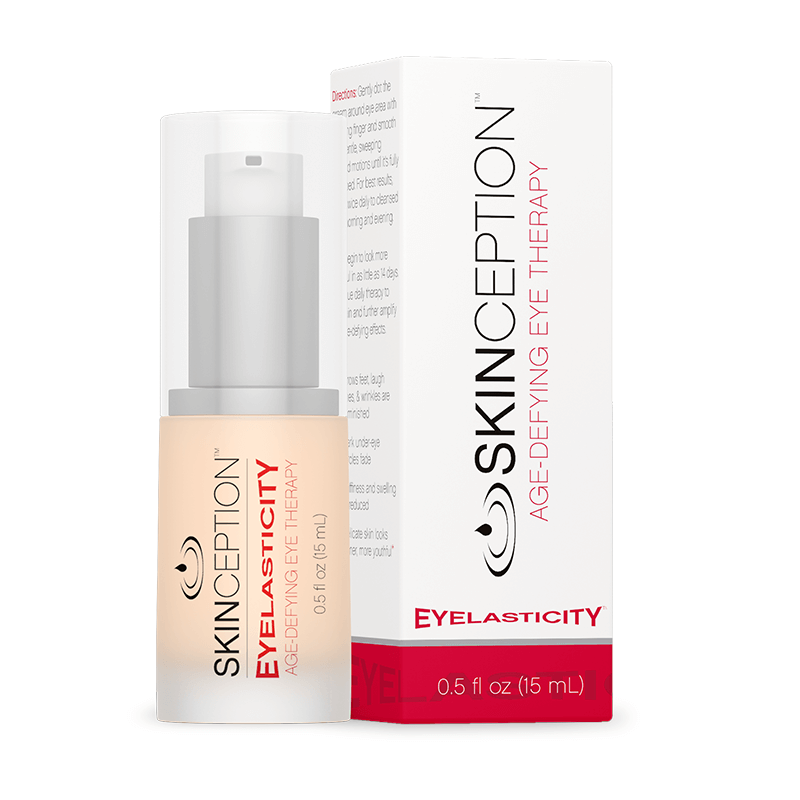
Spotlight: Eyelasticity Age-Defying Eye Therapy
Among the topical eye cream formulations that have gained attention in the anti-aging skincare market, Eyelasticity Age-Defying Eye Therapy stands out for its science-forward approach to periorbital rejuvenation. Eyelasticity is formulated specifically for the delicate under-eye area and addresses multiple signs of aging simultaneously, including dark circles, puffiness, fine lines, and loss of firmness.
Eyelasticity’s formula centers on a blend of clinically studied peptides that target the mechanisms behind under-eye aging. The product features Syn-ake, a synthetic tripeptide that mimics the effect of a temple viper snake venom peptide to temporarily relax facial tension and smooth dynamic wrinkles — functioning in a manner analogous to a topical neurotoxin. It also contains Leuphasyl, a pentapeptide that modulates neurotransmitter signaling at the neuromuscular junction to further reduce expression lines. Together, these peptides work synergistically to soften crow’s feet and forehead lines around the orbital zone.
Beyond peptide technology, Eyelasticity incorporates Eyeseryl, a tetrapeptide clinically shown to reduce under-eye puffiness and dark circles by improving lymphatic drainage and reducing fluid accumulation. Clinical data cited by the manufacturer suggests that Eyeseryl reduced under-eye bag volume in 70% of subjects over a 56-day period. The formula is further supported by hydrating and barrier-repair agents including Hyaluronic Acid and Renovage (teprenone), a genoprotective ingredient that has been studied for its ability to extend skin cell lifespan by protecting telomeres from oxidative shortening.
Eyelasticity is designed for twice-daily application and is suitable for all skin types, including sensitive skin. Users are advised to apply a small amount using the ring finger — the weakest finger, ideal for the gentle pressure needed around the eyes — and to allow the formula to absorb before applying additional products. While individual results vary, consistent use over 4–8 weeks is generally recommended before evaluating full efficacy. As with any topical treatment, Eyelasticity is best understood as one component of a comprehensive under-eye care strategy that includes sun protection, adequate sleep, and appropriate professional treatments when indicated.
Conclusion
Under-eye aging is a multifactorial process influenced by genetics, lifestyle, and cumulative environmental damage. Effective management requires matching the treatment to the underlying cause — whether pigmentary, vascular, structural, or textural. A layered approach combining daily sun protection, evidence-based topical ingredients (retinoids, vitamin C, peptides), strategic lifestyle habits, and selective professional treatments offers the best outcomes.
As the science of skin aging advances, so do the formulations and technologies available to consumers and clinicians alike. Whether you’re just beginning to notice the first signs of periorbital aging or seeking to address more established concerns, the most important step is to act with consistency, patience, and evidence-guided expectations.
References
Bhawan, J., et al. (1996). Photoaging versus intrinsic aging: A morphologic assessment of facial skin. Journal of Cutaneous Pathology, 23(2), 154–162.
Fisher, G.J., et al. (2008). Mechanisms of photoaging and chronological skin aging. Archives of Dermatology, 138(11), 1462–1470.
Flament, F., et al. (2013). Effect of the sun on visible clinical signs of aging in Caucasian skin. Clinical, Cosmetic and Investigational Dermatology, 6, 221–232.
Goldberg, R.A. (2013). The evolving cosmetic surgery. Dermatologic Surgery, 39(7), 1074–1075.
Herman, A., & Herman, A.P. (2013). Caffeine’s mechanisms of action and its cosmetic use. Skin Pharmacology and Physiology, 26(1), 8–14.
Kligman, A.M., & Kligman, L.H. (1998). Photoaging: Same torts, different judgments. Journal of the European Academy of Dermatology and Venereology, 11(Suppl 1), S2–S7.
Pinnell, S.R., et al. (2001). Topical L-ascorbic acid: Percutaneous absorption studies. Dermatologic Surgery, 27(2), 137–142.
Sharad, J. (2012). Dermal fillers for the treatment of tear trough deformity: A review of anatomy, treatment techniques, and their outcomes. Journal of Cutaneous and Aesthetic Surgery, 5(4), 229–238.
Sheth, P.B., & Pandya, A.G. (2011). Melasma: A comprehensive update. Journal of the American Academy of Dermatology, 65(4), 689–697.