

Wellness & Longevity | 10 min read | Peer-reviewed references
Human Growth Hormone (HGH) is often called the “youth hormone” for good reason. It governs everything from muscle mass and fat metabolism to cellular repair and energy levels — and its natural decline after your 30s is one of the central mechanisms of biological aging.
By your 40s, your pituitary gland is secreting roughly half the HGH it produced at its peak. By your 60s, levels may fall to just 15–20% of youthful output. But here’s the encouraging part: the pituitary gland retains the capacity to produce HGH well into old age. The challenge isn’t a broken factory — it’s that the factory has been given fewer and fewer orders. The right lifestyle inputs can change that.
What Is Human Growth Hormone?
HGH is a peptide hormone secreted by the anterior pituitary gland in a pulsatile pattern, primarily during deep (slow-wave) sleep. It stimulates the liver to produce Insulin-like Growth Factor 1 (IGF-1), which mediates most of HGH’s anabolic and metabolic effects throughout the body. Together, HGH and IGF-1 regulate lean body mass, bone density, fat metabolism, skin thickness, immune function, and cardiovascular health.
Unlike testosterone or estrogen, which decline in a relatively linear fashion, HGH release is highly responsive to behavior. Sleep quality, diet composition, exercise intensity, stress levels, and even specific amino acid intake can significantly shift how much HGH your pituitary releases on any given night.
10 Evidence-Based Ways to Boost HGH Naturally
1. Prioritize deep, uninterrupted sleep
The majority of daily HGH secretion occurs during slow-wave sleep, particularly in the first 90-minute sleep cycle. Even a single night of poor sleep significantly blunts pituitary output. Aim for 7–9 hours in a cool, dark room with a consistent sleep schedule.
2. Reduce sugar and refined carbohydrates
Insulin and HGH operate in opposition. When blood glucose and insulin are elevated, HGH secretion is suppressed. Limiting sugar — especially in the 2 hours before bed — helps keep insulin low during the critical overnight HGH release window.
3. Practice intermittent fasting
Fasting is one of the most potent natural HGH stimulants. A 2-day fast has been shown to increase HGH levels by as much as 5-fold in some studies. Even a modest 16:8 fasting protocol lowers insulin, reduces IGF-1 signaling, and creates a hormonal environment permissive to HGH release.
4. Do high-intensity interval training (HIIT)
Intense, anaerobic-threshold exercise causes acute spikes in HGH. Sprints, heavy resistance training, and HIIT circuits — especially training to near-failure — trigger the greatest hormonal response. Research shows HGH can spike up to 400–700% above baseline in the 15–30 minutes following intense exercise.
5. Optimize body composition (reduce visceral fat)
Excess abdominal fat is directly linked to reduced HGH secretion. Visceral adipose tissue increases somatostatin — HGH’s natural inhibitor — and impairs pituitary responsiveness. Even modest reductions in belly fat can meaningfully restore HGH pulsatility.
6. Supplement with L-arginine and L-glutamine
Several amino acids act as secretagogues — compounds that stimulate the pituitary to release HGH. L-arginine (taken at rest, not pre-workout) has been shown to increase nocturnal HGH release significantly at doses of 5–9 grams. L-glutamine and L-ornithine show similar effects in clinical trials.
7. Manage cortisol and chronic stress
Chronically elevated cortisol — the stress hormone — directly suppresses HGH secretion and increases somatostatin tone. Practices like meditation, yoga, breathwork, and adequate recovery between training sessions all lower cortisol and support the HGH-permissive hormonal environment.
8. Try sauna and heat therapy
Repeated sauna sessions (≥80°C for 20+ minutes) have been shown in Finnish research to increase HGH by 2–5 fold, likely via heat-shock protein pathways and the physiological stress of hyperthermia. Two sessions per week may be sufficient to produce measurable hormonal benefits.
9. Eat adequate protein and avoid late-night eating
Protein provides the amino acid precursors for HGH-stimulating pathways, but equally important is timing. Eating a large carbohydrate-heavy meal 2–3 hours before bed raises insulin at exactly the moment your body needs it lowest for overnight HGH release. A small, protein-rich last meal or an extended eating cutoff of 4+ hours before sleep is optimal.
10. Consider adaptogenic and evidence-backed herbs
Certain botanical compounds show promise in supporting the HGH axis. Velvet bean (Mucuna pruriens) contains L-DOPA, a precursor that stimulates dopaminergic pathways involved in GH release. Ashwagandha reduces cortisol, and Deer Antler Velvet contains IGF-1 precursors. These are best used as part of a comprehensive supplement protocol.
The Role of IGF-1: HGH’s Downstream Messenger
Much of what we attribute to “HGH effects” is actually mediated by IGF-1, produced in the liver in response to HGH stimulation. IGF-1 drives cellular regeneration, muscle protein synthesis, and bone remodeling. As HGH declines with age, so does IGF-1 — creating a feedback loop that accelerates tissue aging, increases fat accumulation, and slows recovery from exercise and illness.
Testing your serum IGF-1 levels is the most practical way to assess your HGH status. IGF-1 reflects integrated HGH output over days rather than the moment-to-moment fluctuations of HGH itself. Many functional medicine physicians now track IGF-1 as part of longevity-focused panels.
What About Synthetic HGH Injections?
Prescription recombinant HGH (somatropin) is FDA-approved for specific medical conditions — adult growth hormone deficiency, HIV-related muscle wasting, and several pediatric growth disorders. When medically indicated, it can be transformative. However, exogenous HGH carries meaningful risks: elevated cancer risk (IGF-1 is mitogenic), fluid retention, carpal tunnel syndrome, joint pain, and — crucially — it suppresses the pituitary’s own production, potentially leading to dependence.
For the vast majority of aging adults who are not clinically deficient, supporting the body’s own HGH secretion through the lifestyle and nutritional strategies above is both safer and more sustainable than pharmaceutical intervention.
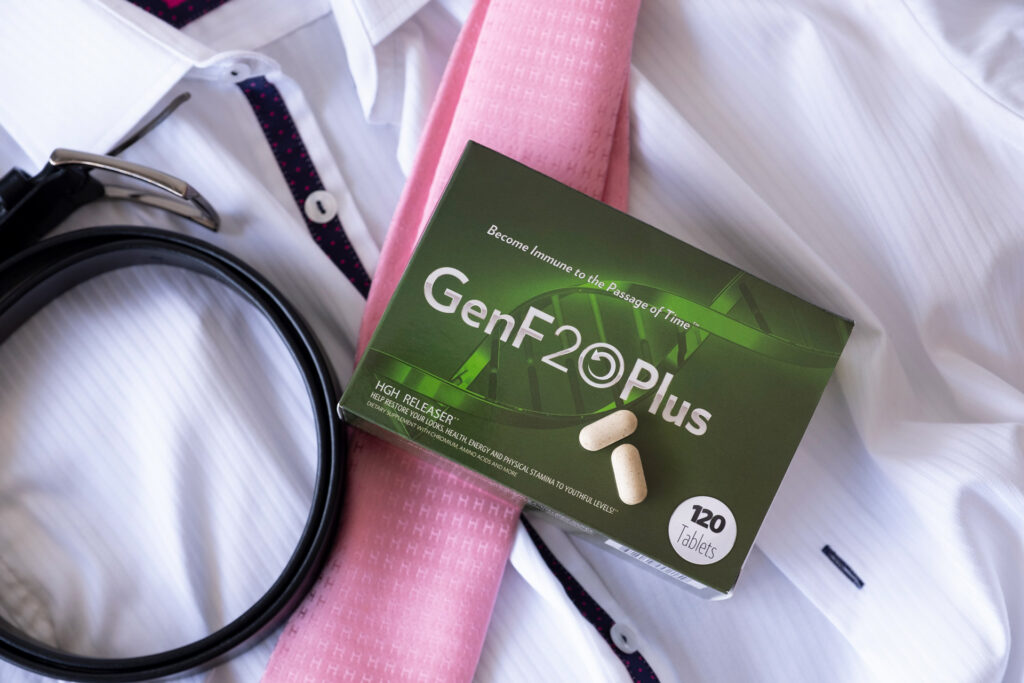
GenF20 Plus®: A Science-Formulated HGH Releaser
For those who want to go beyond lifestyle alone, GenF20 Plus® is one of the most clinically studied natural HGH support formulas on the market. Unlike synthetic HGH injections, GenF20 Plus® works as a secretagogue — a compound that encourages your own pituitary gland to produce and release more growth hormone naturally. Its proprietary blend includes a carefully selected matrix of amino acids known to stimulate HGH secretion, including L-arginine (520 mg), L-glutamine, L-lysine, L-tyrosine, and L-glycine, alongside anterior pituitary peptides and deer antler velvet extract. This combination targets the hypothalamic-pituitary axis through multiple complementary pathways.
What distinguishes GenF20 Plus® is its clinical backing. A double-blind, placebo-controlled clinical trial reported that the formula significantly increased IGF-1 levels compared to placebo — a meaningful marker of elevated HGH output. The formula also includes astragalus root extract for absorption enhancement and cellular health support, phosphatidyl choline to improve bioavailability, and GTF chromium to help regulate blood sugar and maintain an insulin environment supportive of HGH release. GenF20 Plus® is available in both tablet and oral spray form, with the spray delivering Alpha-GPC — a compound shown in its own right to potentiate HGH response to exercise. For adults in their 40s, 50s, and beyond who are committed to optimizing their hormonal environment through natural means, GenF20 Plus® represents a thoughtfully formulated complement to the lifestyle strategies covered in this article.
References
- Veldhuis, J.D., et al. (2000). “Endocrine control of body composition in infancy, childhood, and puberty.” Endocrine Reviews, 21(5), 460–498.
- Ho, K.Y., et al. (1988). “Fasting enhances growth hormone secretion and amplifies the complex rhythms of growth hormone secretion in man.” Journal of Clinical Investigation, 81(4), 968–975.
- Hartman, M.L., et al. (1992). “Augmented growth hormone secretory burst frequency and amplitude mediate enhanced GH secretion during a two-day fast in normal men.” Journal of Clinical Endocrinology & Metabolism, 74(4), 757–765.
- Weltman, A., et al. (1992). “Endurance training amplifies the pulsatile release of growth hormone.” Journal of Applied Physiology, 72(6), 2188–2192.
- Corpas, E., Harman, S.M., & Blackman, M.R. (1993). “Human growth hormone and human aging.” Endocrine Reviews, 14(1), 20–39.
- Vgontzas, A.N., et al. (2000). “Sleep and its disorders.” Annual Review of Medicine, 51, 341–356.
- Chromiak, J.A., & Antonio, J. (2002). “Use of amino acids as growth hormone-releasing agents by athletes.” Nutrition, 18(7–8), 657–661.
- Leppäluoto, J., et al. (2008). “Growth hormone and cortisol secretion is enhanced after brief daily sauna bathing.” Growth Hormone & IGF Research, 18(5), 453.
- Giustina, A., & Veldhuis, J.D. (1998). “Pathophysiology of the neuroregulation of growth hormone secretion in experimental animals and the human.” Endocrine Reviews, 19(6), 717–797.
- Rudman, D., et al. (1990). “Effects of human growth hormone in men over 60 years old.” New England Journal of Medicine, 323(1), 1–6.
- Klatz, R., & Goldman, R. (2007). Grow Young with HGH. HarperCollins.
- Merimee, T.J., et al. (1969). “Arginine-initiated release of human growth hormone.” NEJM, 280(26), 1434–1438.