

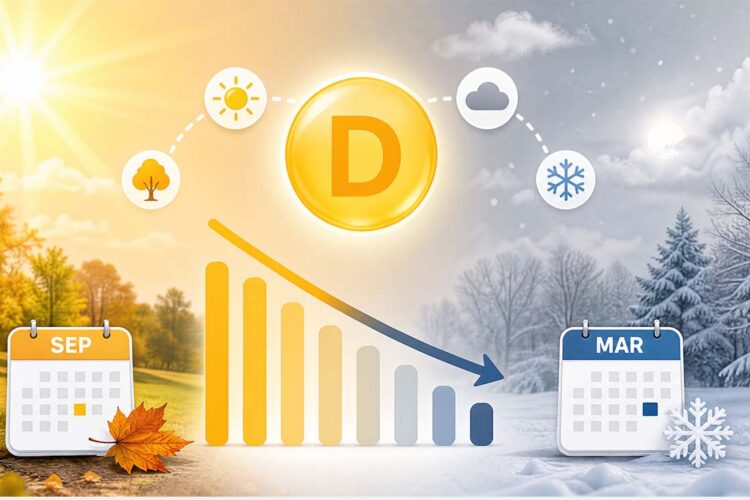
Something predictable happens to your body every autumn, and almost nobody notices it while it is happening.
Around the end of summer, your vitamin D level is at its highest point of the entire year. By late February, for most people living north of roughly the 35th parallel, it will be at its lowest. Nothing about your diet has to change. Nothing about your routine has to change. The sun simply moves, and your body stops making the vitamin it was making freely three months earlier.
This is not a marketing story. It is a well documented seasonal pattern, and understanding the timeline is the difference between reacting in February and preparing in September.
Why the sun stops working
Your skin does not make vitamin D from sunlight in general. It makes vitamin D from a narrow slice of ultraviolet radiation called UVB, at wavelengths of roughly 290 to 315 nanometres.
UVB has to travel through the atmosphere to reach you, and the distance it travels depends entirely on the angle of the sun. When the sun sits high overhead in June, UVB takes a short, direct path through the ozone layer and plenty of it lands on your skin. When the sun sits low in the sky in November, that same radiation enters at a shallow angle, travels through far more atmosphere, and the ozone layer absorbs almost all of it before it ever reaches the ground.
There is a rough field test for this. Stand outside and look at your shadow. If your shadow is longer than you are tall, the sun is too low for meaningful vitamin D synthesis. In a northern winter, that describes most of the daylight hours.
Classic research from Boston, at 42 degrees north, found that skin exposed to sunlight produced essentially no vitamin D3 from November through February. In Edmonton, at 52 degrees north, that window stretched from October through March. Farther south, in places like Los Angeles, synthesis continued year round. Latitude is the single biggest variable in whether you have a vitamin D winter at all.
Your body has a reserve tank, and it drains slowly
Here is why the drop is gradual rather than sudden.
The form of vitamin D measured in a blood test, 25-hydroxyvitamin D, has a circulating half life of roughly two to three weeks. Your body also stores vitamin D in fat and muscle tissue, which extends the buffer further. So when UVB switches off in the fall, you do not crash. You coast.
That coasting period is exactly what makes the seasonal decline so easy to miss. You are spending down a reserve built in July, and the balance does not run low until the days are already short and cold. By the time anyone thinks to ask why they feel flat, the tank has been draining for four months.
The September to March timeline
| Month | What is happening with UVB | Where levels typically sit |
| September | Sun angle falls below the synthesis threshold for most of the day at northern latitudes. Outdoor time drops with the temperature. | Annual peak, or just past it |
| October | Above roughly 37 degrees north, skin production becomes minimal on most days | The slow decline begins |
| November | Vitamin D winter across most of the northern United States, Canada, the UK, and northern Europe | Measurably below summer levels |
| December | Shortest days, lowest sun angle, most hours spent indoors | Running almost entirely on stored reserves |
| January | No meaningful production. Reserves thinning. | Approaching the annual low |
| February | Still no meaningful production across most of North America | The typical annual nadir for most people |
| March | UVB begins returning at mid latitudes late in the month | Lowest point for many, with slow recovery ahead |
The practical takeaway sits in the first row. September is not the month you notice the problem. September is the month the decline starts, which makes it the most useful month to act.
Some people fall further and faster
The seasonal curve is universal. The depth of it is not.
| Factor | Why it steepens the drop |
| Latitude | The farther north you live, the longer your vitamin D winter runs |
| Age | The skin’s supply of 7-dehydrocholesterol, the precursor compound, declines substantially with age, so older skin produces less D3 from the same sun exposure |
| Skin tone | Melanin is a natural UV filter. Deeper skin tones require significantly longer sun exposure to produce the same amount of vitamin D |
| Body composition | Vitamin D is fat soluble and is sequestered in adipose tissue, which lowers the amount circulating in the blood |
| Indoor work | Window glass blocks UVB almost completely. A sunny office is not a vitamin D source |
| Sunscreen and covering up | Correctly applied SPF 30 blocks the large majority of UVB. Necessary for skin protection, but it does reduce synthesis |
| Diet | Very few foods carry meaningful vitamin D. Fatty fish is the main exception, and most people are not eating salmon daily |
Food deserves a moment here, because it is the fallback most people assume will cover them. A serving of salmon can supply several hundred international units. An egg yolk supplies a few dozen. A glass of fortified milk supplies about a hundred. Adding those up across a realistic day, most people are not replacing what a single summer afternoon outdoors used to produce.
Why vitamin D alone leaves a job half finished
Now the part that most seasonal vitamin D articles skip.
One of vitamin D’s central jobs is increasing how much calcium you absorb from your gut into your bloodstream. That is genuinely useful. Without adequate vitamin D, dietary calcium largely passes through without being absorbed at all.
But absorption is only step one. Once calcium is circulating in your blood, something has to direct it to the right destination. You want that calcium in bone and dental tissue. You do not want it accumulating in arterial walls, where calcification contributes to stiffening and reduced flexibility over time.
That directing job belongs to vitamin K2. K2 activates two calcium binding proteins: osteocalcin, which helps bind calcium into the bone matrix, and matrix Gla protein, which helps keep calcium out of soft tissue including arterial walls. Without enough K2 available, those proteins remain inactive and calcium is far less likely to end up where you actually want it.
This is why the two vitamins are often described together as a calcium traffic system. Vitamin D opens the door. Vitamin K2 directs the traffic. Taking one without the other means half a system.
How GenuinePurity® Vitamin K2/D3 fits the season
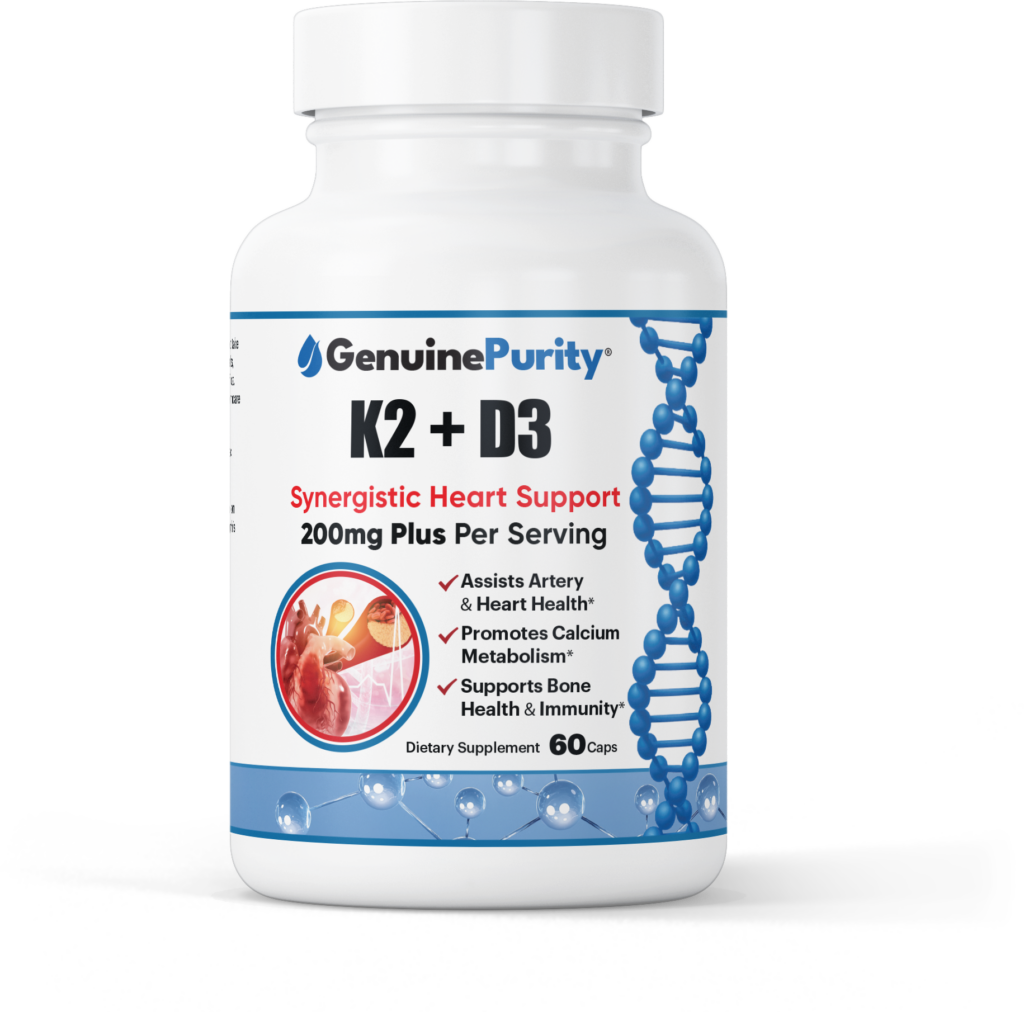
GenuinePurity® Vitamin K2/D3 was formulated around that pairing rather than around vitamin D on its own. Here is what a single daily capsule contains.
| Ingredient | Per capsule | Role in the formula |
| Vitamin D3 (cholecalciferol) | 125 mcg (5,000 IU) | The same form your skin produces under UVB, and the form research consistently shows raises circulating vitamin D more effectively than D2 |
| Vitamin K2 (MK-7, menaquinone-7) | 100 mcg | The long acting form of K2. MK-7 stays in circulation considerably longer than MK-4, which is why a single daily serving is sufficient |
| Calcium (as calcium carbonate) | Included | Calcium carbonate carries a higher proportion of elemental calcium than several other common forms |
| BioPerine® (black pepper extract) | 5 mg | A patented piperine extract that supports the absorption of both fat soluble vitamins |
A few things worth saying plainly about this formula.
The D3 is cholecalciferol, which is chemically identical to what your own skin manufactures when UVB hits it. That matters more than it sounds. Vitamin D2, used in many cheaper products, is less efficient at raising and holding circulating levels.
The K2 is MK-7 rather than MK-4. This is the more meaningful of the two decisions. MK-4 clears from the body quickly enough that it realistically requires multiple daily doses to sustain useful blood levels. MK-7 has a much longer half life, which is what makes one capsule a day a workable format.
The whole thing is delivered in a single vegetable capsule, taken roughly 20 to 30 minutes after a meal. Because both vitamins are fat soluble, taking them alongside food that contains some fat genuinely improves how much you absorb. This is not a detail to skip.
GenuinePurity® manufactures in cGMP certified facilities in the United States and publishes third party Certificates of Analysis for its products, which you can request or review before buying. That last habit is worth applying to any supplement you consider, from any brand.
What to actually do about the next six months
Start before the decline, not after it. The most useful window opens in late August and September, while your levels are still near their annual peak. Supporting from the top of the curve is a very different exercise from trying to climb back out of the bottom of it in February.
Be consistent rather than occasional. Because of the multi week half life, vitamin D status responds to sustained daily intake, not to remembering twice a week.
Take it with food. Fat soluble means fat soluble. A capsule taken with a meal containing some fat is absorbed noticeably better than one taken on an empty stomach.
Get tested if you want to know where you actually stand. A 25-hydroxyvitamin D blood test is inexpensive and widely available, and it turns this entire subject from guesswork into a number. If you test, the most informative time is late winter, when you are seeing your true low point.
Talk to your doctor first if any of the following apply to you. This one is important rather than boilerplate. Vitamin K interacts meaningfully with warfarin and other anticoagulant medications, so anyone taking a blood thinner should speak with their prescriber before adding a K2 supplement. Anyone who is pregnant or nursing, managing a kidney condition, taking calcium affecting medication, or already supplementing vitamin D at a high dose should also check in before starting.
The short version
Your vitamin D level is not stable across the year. It peaks around the end of summer, declines steadily from September as the sun angle drops below the threshold for skin synthesis, and bottoms out in late winter. The decline is gradual because your body carries a reserve, which is precisely why most people never connect the timing.
Vitamin D3 handles calcium absorption. Vitamin K2 handles calcium placement. GenuinePurity® Vitamin K2/D3 supplies both in a single daily capsule, with MK-7 as the K2 form and cholecalciferol as the D3 form, supported by BioPerine® for absorption.
The sun is already lower today than it was in June. September is the month to get ahead of it.
References
- Holick MF. Vitamin D deficiency. New England Journal of Medicine. 2007;357(3):266-281.
- Webb AR, Kline L, Holick MF. Influence of season and latitude on the cutaneous synthesis of vitamin D3. Journal of Clinical Endocrinology and Metabolism. 1988;67(2):373-378.
- Jones G. Pharmacokinetics of vitamin D toxicity. American Journal of Clinical Nutrition. 2008;88(2):582S-586S.
- Sato T, Schurgers LJ, Uenishi K. Comparison of menaquinone-4 and menaquinone-7 bioavailability in healthy women. Nutrition Journal. 2012;11:93.
- Knapen MHJ, Drummen NE, Smit E, Vermeer C, Theuwissen E. Three-year low-dose menaquinone-7 supplementation helps decrease bone loss in healthy postmenopausal women. Osteoporosis International. 2013;24(9):2499-2507.
- van Ballegooijen AJ, Pilz S, Tomaschitz A, Grübler MR, Verheyen N. The synergistic interplay between vitamins D and K for bone and cardiovascular health: a narrative review. International Journal of Endocrinology. 2017;2017:7454376.
- Institute of Medicine. Dietary Reference Intakes for Calcium and Vitamin D. Washington, DC: National Academies Press; 2011.