


Somewhere in early September, the light changes before the weather does. The sun comes up later, sets earlier, and sits lower in the sky. You may notice you are slower to get moving in the morning, hungrier around four in the afternoon, and ready for bed by nine without having done anything to earn it.
That is not a lack of discipline. It is a measurable biological response to a measurable environmental change. Your brain tracks the length of the day with more precision than you do, and it adjusts three systems in particular: serotonin signaling, sleep timing, and appetite. Here is what the research actually shows, and what the evidence supports doing about it.
YOUR BRAIN MEASURES DAYLIGHT WHETHER YOU NOTICE IT OR NOT
A specialized set of cells in your retina exists for one purpose, and it is not vision. These cells contain a pigment called melanopsin and they report light levels directly to the suprachiasmatic nucleus, the master clock in your hypothalamus. That clock uses the report to set the timing of nearly every daily rhythm in your body, including cortisol release in the morning, core body temperature, and melatonin release at night.
The catch is that these cells respond to intensity, and indoor light is far dimmer than most people assume. A well lit office runs somewhere around 300 to 500 lux. An overcast morning outdoors is often 10,000 lux or more. Direct sunlight can exceed 100,000. From your clock’s point of view, a full day spent indoors in autumn is close to an extended twilight. As the outdoor day shortens, the number of hours in which you are likely to catch genuinely bright light shrinks faster than the calendar suggests.
SEROTONIN FOLLOWS THE SUN
The most direct human evidence on this comes from a study published in The Lancet in 2002. Researchers sampled blood from the internal jugular veins of 101 healthy men, which allowed them to estimate how much serotonin the brain was actually producing rather than inferring it from peripheral markers. Serotonin turnover was lowest in winter. More telling, the rate of serotonin production tracked the number of hours of bright sunlight on the day of sampling, and it rose quickly as luminosity increased (Lambert et al., 2002).
A second line of evidence looks at what happens to serotonin once it is released. A 2008 PET imaging study measured serotonin transporter binding, which reflects how aggressively serotonin is cleared out of the synapse. Binding was significantly higher in fall and winter than in spring and summer (Praschak-Rieder et al., 2008). Read the two studies together and the picture is that in the darker months the brain may make somewhat less serotonin while clearing it more efficiently. Less in, more out.
It is worth being precise about what this does and does not mean. These are population level findings with real variation between individuals, and low serotonin turnover is not a diagnosis. But it does help explain why the seasonal shift so many people describe is not imaginary.
LONGER NIGHTS, A LONGER MELATONIN SIGNAL
In most mammals, the length of the nightly melatonin signal is the message that carries the season. Melatonin is released only in darkness, so longer nights produce a longer signal, and that signal drives seasonal changes in behavior.
Humans retain this machinery. In a controlled experiment, healthy volunteers were exposed to a summer style photoperiod of 16 hours light and 8 hours darkness, then to a winter style photoperiod of 10 hours light and 14 hours darkness. Under the shorter photoperiod, the duration of nocturnal melatonin secretion lengthened, and sleep duration lengthened with it (Wehr, 1991). A later review confirmed that the retinal to pineal pathway responsible for this is well conserved in people (Wehr, 1997).
There is an important modern wrinkle. Under strictly controlled laboratory photoperiods, most people show the response. Out in ordinary urban life, with electric light in the evening and dim light during the day, the seasonal signal is blunted and far less consistent from person to person. Reviews of the epidemiology suggest that roughly a quarter of the population experiences seasonal changes in mood and behavior significant enough to cause at least mild problems. In other words, artificial light has partly disconnected us from the seasons, but only partly, and the disconnection is not evenly distributed.
The practical version: as nights get longer, many people find their sleep drifts later, feels less restorative, and produces morning grogginess that lingers well past the alarm.
APPETITE, AND WHY IT ASKS FOR CARBOHYDRATES
The appetite piece of this puzzle is the one people find most surprising, because it feels like a willpower failure rather than a physiological one.
Serotonin is involved in the regulation of satiety and macronutrient selection, and researchers have documented for decades that episodic carbohydrate craving clusters together with low mood, appearing in seasonal affective disorder, premenstrual syndrome, and carbohydrate craving obesity (Wurtman and Wurtman, 1995). In a study comparing carbohydrate rich and protein rich meals, patients with seasonal affective disorder reported that carbohydrate ingestion energized them, in contrast to control subjects (Rosenthal et al., 1989).
The proposed mechanism is elegant. Tryptophan, the amino acid your body uses to build serotonin, competes with several other large neutral amino acids for the same transporter into the brain. A carbohydrate rich meal triggers insulin, insulin pulls the competing amino acids into muscle tissue, and tryptophan’s share of the transporter goes up. More tryptophan reaches the brain, and serotonin synthesis follows.
That mechanism is a hypothesis with strong supporting evidence rather than a settled fact, and the size of the effect in ordinary diets is debated. But it offers a reasonable frame for the four o’clock cookie in October. The craving may be a rough attempt at self correction, not a character flaw. That does not make an unlimited pastry budget a good plan, but it does suggest that treating the craving as an enemy to be white knuckled is the wrong strategy.
WHEN A SEASONAL SHIFT BECOMES SOMETHING MORE
The clinical version of this pattern was first described in 1984, when researchers characterized seasonal affective disorder and reported preliminary results using light therapy (Rosenthal et al., 1984). It is estimated to affect somewhere between one and six percent of people, with higher prevalence at more extreme latitudes, and it tends to present with atypical features: sleeping more rather than less, craving carbohydrates, gaining weight, and feeling heavy and slowed down.
Light therapy has held up reasonably well under scrutiny. A meta- analysis of randomized controlled trials found that bright light treatment and dawn simulation for seasonal affective disorder, along with bright light for nonseasonal depression, produced effect sizes comparable to those seen in most antidepressant medication trials. The same analysis was blunt about the fact that many published reports of light therapy do not meet rigorous design standards (Golden et al., 2005).
WHAT ACTUALLY HELPS
Get outdoor light early. This is the single highest leverage change, and it costs nothing. Twenty to thirty minutes outside within an hour or so of waking gives your clock a strong, unambiguous morning signal. Overcast still counts. Through a window does not count for much, because glass and distance cut intensity dramatically.
Hold your wake time steady. Your clock anchors more firmly to when you wake and see light than to when you go to bed. A wake time that stays within about an hour across the week, weekends included, does more for autumn energy than an extra hour of weekend sleep.
Consider a light box, and use it correctly. The standard protocol is 10,000 lux for roughly 20 to 30 minutes shortly after waking, positioned off to the side rather than stared into. Timing matters, and evening use can backfire by pushing your clock later. Anyone with a bipolar diagnosis, an eye condition, or a photosensitizing medication should speak with a clinician first.
Protect the dark end of the day. Bright overhead light and screens late in the evening delay melatonin onset, which compounds the problem the season already created. Dimmer, lower, warmer light after sunset costs you nothing.
Move, ideally outside. Physical activity has consistent antidepressant effects independent of light, and doing it outdoors buys you both at once.
Eat in a way that steadies you. Protein at breakfast, meals at reasonably consistent times, and pairing the carbohydrate you crave with protein, fat, or fiber tends to work better than trying to eliminate it. Restriction usually intensifies the craving rather than resolving it.
Stay connected. Autumn withdrawal is self reinforcing, and social contact is one of the few interventions that reliably interrupts the loop.
WHEN TO TALK TO SOMEONE
Seasonal dips are common. Persistent low mood is a different matter. If low mood, fatigue, or loss of interest lasts more than two weeks, interferes with your work or relationships, or returns predictably every year with real severity, that is worth a conversation with a doctor. Effective treatments exist, and seasonal patterns respond particularly well when addressed early rather than in February. If you are having thoughts of harming yourself, please reach out to a healthcare provider or a crisis line right away.
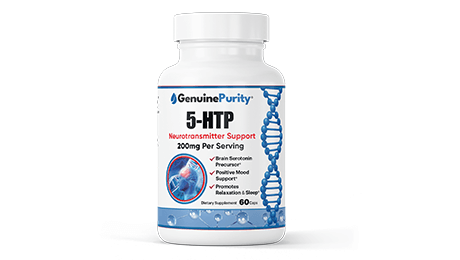
A NOTE ON GENUINEPURITY® 5-HTP
Because the seasonal picture involves serotonin so directly, 5-HTP is a compound that comes up often at this time of year. 5-HTP, or 5-hydroxytryptophan, is the intermediate step between tryptophan and serotonin. It matters biochemically because it sits after the rate limiting step in the pathway. Tryptophan has to be converted by tryptophan hydroxylase before anything else can happen, and much of the tryptophan you consume is diverted down other metabolic routes entirely. 5-HTP skips that bottleneck. It is well absorbed orally, does not require a transport molecule to reach the brain, and crosses the blood brain barrier readily (Birdsall, 1998; Turner et al., 2006).
GenuinePurity® 5-HTP provides 200 mg of plant- based 5-hydroxytryptophan per capsule, extracted from the seeds of Griffonia simplicifolia, the West African shrub that is the primary natural source of the compound. The formula is deliberately simple: 5-HTP, calcium carbonate to support stability and absorption through digestion, and a vegetable capsule. No artificial colors, no unnecessary fillers. It is vegan, gluten free, and non-GMO, produced in cGMP certified facilities and third party tested for purity and potency, with 60 capsules per bottle.
We want to be straight with you about the evidence, because that is how we prefer to talk about our products. A Cochrane review of the literature on 5-HTP and tryptophan for depression found that while available evidence suggested both performed better than placebo, only a small number of the 108 identified studies met sufficient quality standards to be included, and the reviewers called for better research before drawing strong conclusions (Shaw et al., 2002). That is an honest reflection of where the science sits: a well understood mechanism, encouraging findings, and a genuine need for more rigorous trials. 5-HTP is best thought of as one part of a seasonal routine built primarily on morning light, consistent sleep timing, and movement, rather than a replacement for any of them.
One safety point deserves emphasis. Because 5-HTP raises serotonin, it should not be combined with SSRIs, SNRIs, MAOIs, tricyclic antidepressants, triptans, tramadol, or any other serotonergic medication except under the supervision of a healthcare provider, due to the risk of serotonin syndrome. It is also not recommended during pregnancy or breastfeeding, or for anyone under 18. If you take any prescription medication or have a diagnosed condition, talk with your doctor before starting.
REFERENCES
Birdsall, T. C. (1998). 5-Hydroxytryptophan: A clinically-effective serotonin precursor. Alternative Medicine Review, 3(4), 271-280.
Golden, R. N., Gaynes, B. N., Ekstrom, R. D., Hamer, R. M., Jacobsen, F. M., Suppes, T., Wisner, K. L., and Nemeroff, C. B. (2005). The efficacy of light therapy in the treatment of mood disorders: A review and meta-analysis of the evidence. American Journal of Psychiatry, 162(4), 656-662. doi:10.1176/appi.ajp.162.4.656
Lambert, G. W., Reid, C., Kaye, D. M., Jennings, G. L., and Esler, M. D. (2002). Effect of sunlight and season on serotonin turnover in the brain. The Lancet, 360(9348), 1840-1842. doi:10.1016/S0140-6736(02)11737-5
Praschak-Rieder, N., Willeit, M., Wilson, A. A., Houle, S., and Meyer, J. H. (2008). Seasonal variation in human brain serotonin transporter binding. Archives of General Psychiatry, 65(9), 1072-1078. doi:10.1001/archpsyc.65.9.1072
Rosenthal, N. E., Sack, D. A., Gillin, J. C., Lewy, A. J., Goodwin, F. K., Davenport, Y., Mueller, P. S., Newsome, D. A., and Wehr, T. A. (1984). Seasonal affective disorder: A description of the syndrome and preliminary findings with light therapy. Archives of General Psychiatry, 41(1), 72-80. doi:10.1001/archpsyc.1984.01790120076010
Rosenthal, N. E., Genhart, M. J., Caballero, B., Jacobsen, F. M., Skwerer, R. G., Coursey, R. D., Rogers, S., and Spring, B. J. (1989). Psychobiological effects of carbohydrate- and protein-rich meals in patients with seasonal affective disorder and normal controls. Biological Psychiatry, 25(8), 1029-1040. doi:10.1016/0006-3223(89)90291-6
Shaw, K., Turner, J., and Del Mar, C. (2002). Tryptophan and 5-hydroxytryptophan for depression. Cochrane Database of Systematic Reviews, (1), CD003198. doi:10.1002/14651858.CD003198
Turner, E. H., Loftis, J. M., and Blackwell, A. D. (2006). Serotonin a la carte: Supplementation with the serotonin precursor 5-hydroxytryptophan. Pharmacology and Therapeutics, 109(3), 325-338. doi:10.1016/j.pharmthera.2005.06.004
Wehr, T. A. (1991). The durations of human melatonin secretion and sleep respond to changes in daylength (photoperiod). Journal of Clinical Endocrinology and Metabolism, 73(6), 1276-1280. doi:10.1210/jcem-73-6-1276
Wehr, T. A. (1997). Melatonin and seasonal rhythms. Journal of Biological Rhythms, 12(6), 518-527. doi:10.1177/074873049701200605
Wurtman, R. J., and Wurtman, J. J. (1995). Brain serotonin, carbohydrate-craving, obesity and depression. Obesity Research, 3(S4), 477S-480S. doi:10.1002/j.1550-8528.1995.tb00215.x