

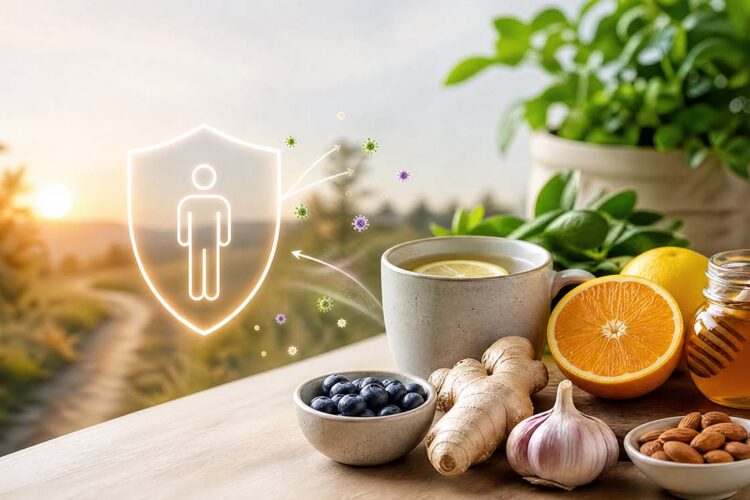
Most people think about their immune system the same way they think about a spare tire. It sits in the background, forgotten, until the moment something goes wrong. Then comes the scramble: the megadose of vitamin C, the elderberry syrup, the zinc lozenges, the frantic search for anything that might shorten the next three days.
There is a problem with that approach, and it has nothing to do with willpower or product quality. It has to do with timing.
Your immune system is not a switch. It is a network of tissues, cells, and signaling molecules that operates on a schedule of weeks and months, not hours. The barrier tissue lining your nose and airways renews itself over days. Immune cell populations turn over on their own cycles. Nutrient stores like vitamin D build slowly and deplete slowly. And the inflammatory balance that determines how efficiently your body responds and then recovers is shaped by months of accumulated habits, not by what you took this morning.
By the time you feel the first scratch in your throat, the conditions that determine how that week goes have already been set.
This article is about the other approach. Not reacting faster, but preparing earlier.
Resilience is a baseline, not a response
There is a useful distinction between immune strength and immune resilience.
Immune strength suggests more: more inflammation, more aggressive response, more of everything. That framing is misleading. An immune system stuck in high alert is not a healthy one. Chronic low-grade inflammation is now recognized as a common thread running through many age-related conditions, and researchers have described it as a background state that quietly reshapes how the body functions over decades.
Immune resilience is different. It describes a system that responds appropriately when challenged, then resolves cleanly afterward. It mounts a response proportional to the threat, does its work, and returns to baseline without leaving behind a smoldering inflammatory residue.
That capacity to resolve is arguably the more important half of the equation, and it is the half most seasonal supplement routines ignore entirely.
What actually shapes seasonal resilience
Four things do most of the work, and none of them respond to last-minute intervention.
Barrier integrity. Your respiratory and gut linings are the first point of contact. Cold, dry air stresses the airway lining. Dehydration thins the mucus layer that traps particles. These tissues need consistent support to stay intact through a season, not a rescue effort in week one.
Innate response speed. The first responders of your immune system act within hours. How efficiently they work depends on the metabolic and nutritional environment they are operating in, which is set by weeks of prior intake.
Inflammatory balance. This is the resolution question. Does your body know how to turn the response off? Balanced inflammatory signaling is what separates a two-day event from a two-week one.
Recovery capacity. Cellular repair, mitochondrial function, and sleep quality all determine how quickly you return to normal. These are the slowest systems to build and the first to erode under stress.
Notice the pattern. Every one of these is a baseline condition. You are not building them during a challenge. You are drawing on what you already built.
The cellular layer most people miss: senescent cells
There is one more factor that deserves attention, particularly for anyone over forty.
Your body constantly replaces old cells with new ones. Occasionally that process stalls. Instead of being cleared away, a damaged cell enters a state called senescence. It stops dividing, but it does not die. Researchers sometimes call these “zombie” cells, and they are not passive. They secrete inflammatory signals into surrounding tissue.
A small number of them is manageable. The problem is that they accumulate with age, while the body’s own ability to clear them slows down. The result is a rising inflammatory background that competes for immune resources and blunts the clean response and resolution cycle described above.
Compounds that help the body clear senescent cells are called senolytics. This is one of the more active areas of longevity research, and quercetin sits near the center of it.
Where quercetin fits
Quercetin is a plant flavonoid found in apples, onions, capers, and berries. It has been studied for decades, with research pointing to several properties relevant to seasonal preparation.
It functions as an antioxidant, helping neutralize free radicals and reduce oxidative stress on tissue, including the barrier tissues that take the brunt of seasonal change.
It supports a healthy inflammatory response, which speaks directly to the resolution half of immune resilience rather than simply pushing the response harder.
It supports healthy immune function and signaling, contributing to the baseline environment your immune cells operate in.
And it acts as a natural senolytic, supporting the body’s clearance of senescent cells. Research in aged mice using a senolytic combination that included quercetin reported meaningful improvements in physical function and lifespan, and a separate human pilot study observed reductions in senescent cell markers within days of a short dosing course.
Taken together, quercetin is not a stimulant for the immune system. It is a conditioning agent for the environment the immune system works in. Which is exactly what a pre-season strategy calls for.
The problem with most quercetin supplements
Here is the catch that undermines a great deal of quercetin supplementation: absorption.
Quercetin has notoriously poor bioavailability. In its standard form, a substantial portion never survives digestion intact, and what does survive is often absorbed inefficiently. Polyphenol bioavailability research has documented this pattern across the class for years.
The practical consequence is that a label claim and a delivered dose are two very different numbers. You can take a generous amount of standard quercetin and have relatively little of it reach systemic circulation.
Dose alone does not solve this. Delivery does.
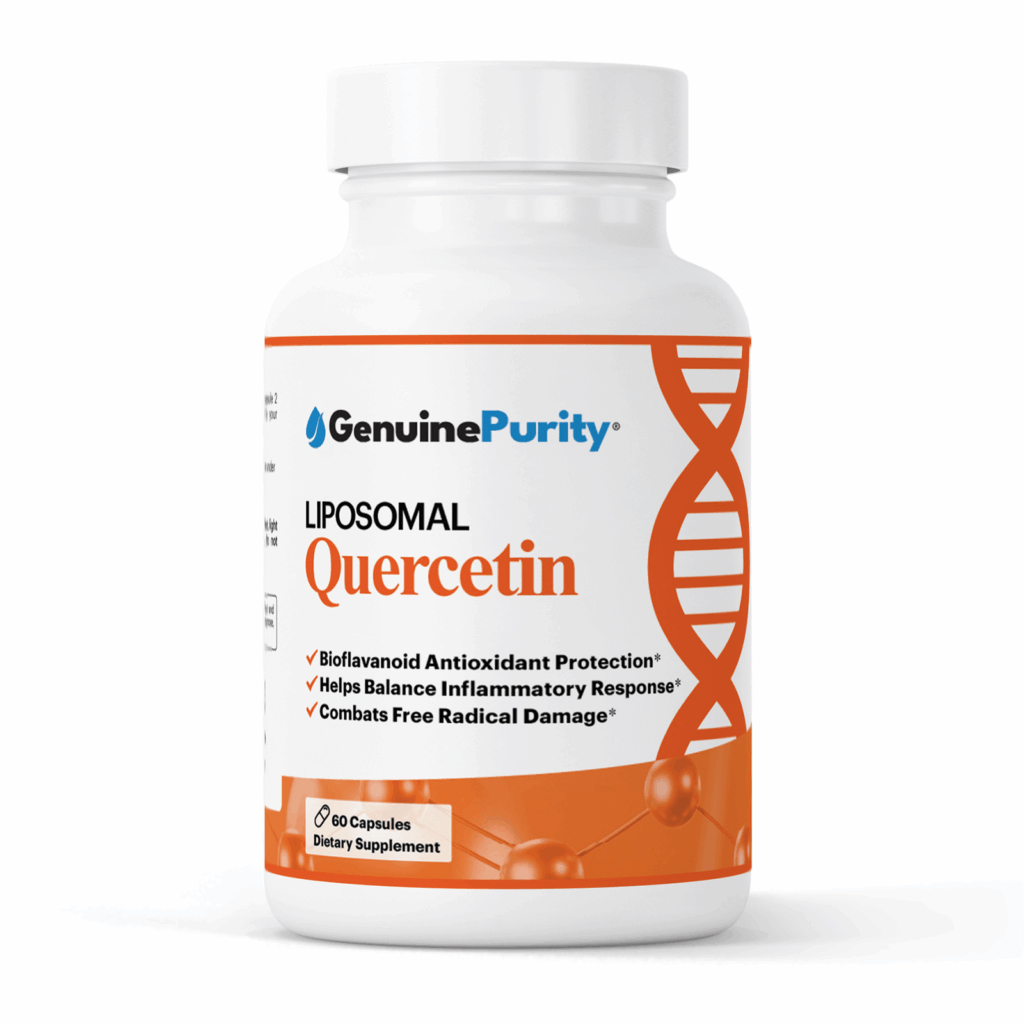
How GenuinePurity® Liposomal Quercetin addresses it
GenuinePurity® Liposomal Quercetin is built around that delivery problem rather than around a bigger number on the label.
Each capsule provides 250 mg of quercetin encapsulated in phospholipid liposomes derived from non-GMO sunflower lecithin. That phospholipid shell is structurally similar to your own cell membranes. It helps shield the quercetin from breakdown during digestion and supports absorption into the bloodstream and uptake into cells, so more of what you take actually arrives where it can do something.
The rest of the formula reflects the same priorities. It is made in the USA in FDA-inspected, cGMP-certified facilities. Every batch is third-party lab tested, with Certificates of Analysis published openly on the GenuinePurity® site. It is vegan-friendly, dairy-free, and made without fillers, GMOs, or preservatives. A bottle contains 60 capsules, a 30-day supply at the directed serving of two capsules daily taken with food. It is covered by a 97-day money-back guarantee.
Building your pre-season routine
If resilience is a baseline, the practical question is when to start and what to pair.
Start eight to twelve weeks ahead. This gives nutrient stores time to fill and gives the slower cellular processes time to respond. Quercetin in particular is a consistency compound, not an acute one. The benefit comes from sustained daily intake.
Take it with food. Two capsules daily with a meal. Dietary fat supports absorption of fat-soluble and liposomal compounds, so pairing with a meal that contains some fat is sensible.
Build the supporting cast. Liposomal Vitamin C complements quercetin’s antioxidant role. Vitamin K2/D3 addresses the seasonal vitamin D decline that comes with shorter days and less sun exposure. Magnesium Complex supports sleep quality and stress regulation, both of which feed directly into recovery capacity. Omega-3 Fish Oil supports the resolution side of inflammatory signaling.
Do not neglect the unsexy inputs. Seven to nine hours of sleep. Adequate protein. Regular movement. Hydration, especially once indoor heating dries the air. No supplement compensates for a deficit in any of these.
Track how you feel, not just what you take. Energy through the afternoon, morning stiffness, recovery time after exertion, and how quickly you bounce back from a rough night are all reasonable informal markers.
The honest expectation
Quercetin is not dramatic. You will not take it on a Monday and feel transformed by Wednesday.
What consistent use supports is a shift in baseline. Steadier energy. Less stiffness. A body that handles the ordinary stresses of a changing season without the whole thing derailing for a week.
The value shows up in what does not happen, which is a difficult thing to market and an easy thing to underestimate.
That is the nature of preparation. The best time to build immune resilience is when you do not feel like you need it.
References
- Li Y, Yao J, Han C, et al. Quercetin, Inflammation and Immunity. Nutrients. 2016;8(3):167.
- Mlcek J, Jurikova T, Skrovankova S, Sochor J. Quercetin and Its Anti-Allergic Immune Response. Molecules. 2016;21(5):623.
- Xu D, Hu MJ, Wang YQ, Cui YL. Antioxidant Activities of Quercetin and Its Complexes for Medicinal Application. Molecules. 2019;24(6):1123.
- Xu M, Pirtskhalava T, Farr JN, et al. Senolytics improve physical function and increase lifespan in old age. Nature Medicine. 2018;24(8):1246-1256.
- Hickson LJ, Langhi Prata LGP, Bobart SA, et al. Senolytics decrease senescent cells in humans: Preliminary report from a clinical trial. EBioMedicine. 2019;47:446-456.
- Manach C, Williamson G, Morand C, Scalbert A, Rémésy C. Bioavailability and bioefficacy of polyphenols in humans. American Journal of Clinical Nutrition. 2005;81(1):230S-242S.
- Furman D, Campisi J, Verdin E, et al. Chronic inflammation in the etiology of disease across the life span. Nature Medicine. 2019;25(12):1822-1832.