


The most common reason a supplement “doesn’t work” is that it was given nine days.
It is worth being straight about this, because November is the month people stock up. A sale is a good moment to buy something. It is a bad moment to find out, six weeks later, that you bought a third of what the research actually used.
Almost nothing in this category produces a noticeable effect in the first week. The handful of things that do are stimulants, and a stimulant is a different kind of product from one that changes how a system is operating. Caffeine works in forty minutes. Nothing that alters a hormone level, a cellular process, or the composition of a tissue works in forty minutes, and the reason is not marketing. It is that your body does not update that quickly.
Your Body Replaces Itself On A Schedule, And It Is Slower Than You Think
Here is the part most people never learn.
The red blood cells carrying oxygen around your body right now have an average working life of roughly 120 days.¹ ² Classic isotope work put the figure at about 127 days, and modern measurement puts the average at 120 days give or take four.¹ ² Whatever number you take, the implication is the same. Change something that affects red blood cell quality today, and the cells that were made under the old conditions are still in circulation four months from now. You are not waiting for the supplement. You are waiting for the population of cells to turn over.
Skin works on a similar principle at a different speed. A careful review of the epidermal turnover literature concluded that a newly formed cell takes somewhere in the region of 40 to 56 days to travel to the surface in normal skin.³ Earlier autoradiographic work put the turnover time of the entire epidermis at 26 to 27 days.⁴ Researchers still argue about exactly where in that range the real number sits, which is itself revealing. Nobody argues about whether it is three days.
This is the thing to hold onto. Your tissues are not static objects that respond to inputs on contact. They are populations being continuously replaced, and the replacement rate sets the floor on how fast anything can change.
Why The Clinical Studies Run 8 To 12 Weeks
Once you know the turnover rates, the shape of the research stops looking arbitrary.
Human trials on hormonal and cellular supplements overwhelmingly run eight to twelve weeks. That is not because researchers enjoy long studies. Long studies are expensive, participants drop out, and every additional week increases the cost and the risk. Researchers run twelve weeks because at four weeks there is frequently nothing statistically meaningful to measure yet.
The study behind one of our own products is a clean example. Fifty male volunteers aged 35 to 65 took 500mg per day of a patented fenugreek seed extract for twelve consecutive weeks.⁵ Twelve weeks. Not four, not six. The researchers chose that window because that is how long it takes for a testosterone change to become visible in a way that survives statistical scrutiny.
If a product’s evidence comes from a twelve week trial, then a one month supply is, quite literally, a third of a trial. You have not tested the product. You have tested the first third of it, under conditions the research never evaluated.
What The Real Timelines Look Like
Here are the published windows on the products people ask us about most. These come from the manufacturers’ own documentation rather than from us, and you can check every one.
GenF20 Plus: the formulation information indicates first anti-aging effects can be expected from around three weeks, with the twelve week double blind study as the reference point for measured IGF-1 change.⁶
HyperGH 14x: the dosing system is described as optimizing natural HGH releasing rhythms in about six weeks, taken as two capsule doses and two oral spray doses per day.⁷
PrimeGENIX Testodren: the clinical work ran twelve weeks at 500mg per day, which is also the period the manufacturer recommends before judging results.⁵ ⁸
Lay those against the amount of time most people actually give a new supplement before deciding it does nothing, and the gap is not subtle. The products are being judged on a fraction of the window their own evidence is built on.
Week Two Feels Like Nothing, And That Is The Expected Shape
This is where most people quit, so it deserves saying plainly.
Biological changes of this kind do not arrive as a switch flipping. They accumulate. A small shift repeats daily, the shifts sum, and at some point the total crosses the threshold where you consciously notice it. Everything before that threshold is real and is doing something. It simply is not perceptible yet.
That produces a specific and very frustrating experience. Week one carries some novelty and some expectation. Week two is flat. Week three is flatter, and by then the novelty has gone and the bottle is sitting on the counter looking like a mistake. The curve of how it feels and the curve of what is happening are genuinely different shapes, and they only converge later.
Knowing this in advance is most of the battle. The flat stretch is not evidence of failure. It is the part of the process that happens before the part you can feel.
How To Tell Whether Something Is Actually Working
Felt effect is a poor instrument, especially over weeks. Memory smooths things, mood colours everything, and nobody can reliably recall how they felt on a Tuesday six weeks ago. Some better approaches:
Write down a baseline before you start. Three or four specific, concrete things. Not “energy” but “how many sets before I am done”, “what time I hit a wall in the afternoon”, “how many days of soreness after legs”. Specific things are comparable later. Vague things are not.
Give it the window the research used. If the trial ran twelve weeks, judge it at twelve weeks. Judging at three is not an early read. It is a different question that the evidence does not answer.
Change one thing at a time. Starting four products in the same week means that in three months you will know something changed and have no idea which bottle did it.
Where a blood marker exists, use it. Testosterone, vitamin D, ferritin and others are measurable. A number taken before and after beats a feeling, every time.
Consider whether you actually took it. This sounds obvious. It is also the single most common reason a supplement produced no result. A ninety day supply taken on sixty days is a sixty day trial, and the gaps rarely fall evenly.
The Practical Consequence For This Month
None of this is an argument against buying anything. It is an argument about what to buy.
A deep discount changes what is affordable, and what it most usefully makes affordable is duration. One bottle of something with a twelve week study behind it is an incomplete experiment. Three bottles of the same thing is an actual test of whether it works for you. Given a choice between four single bottles of four different products and a three month supply of one, the second will tell you something useful and the first almost certainly will not.
Buy fewer things, for longer. That is the whole recommendation.
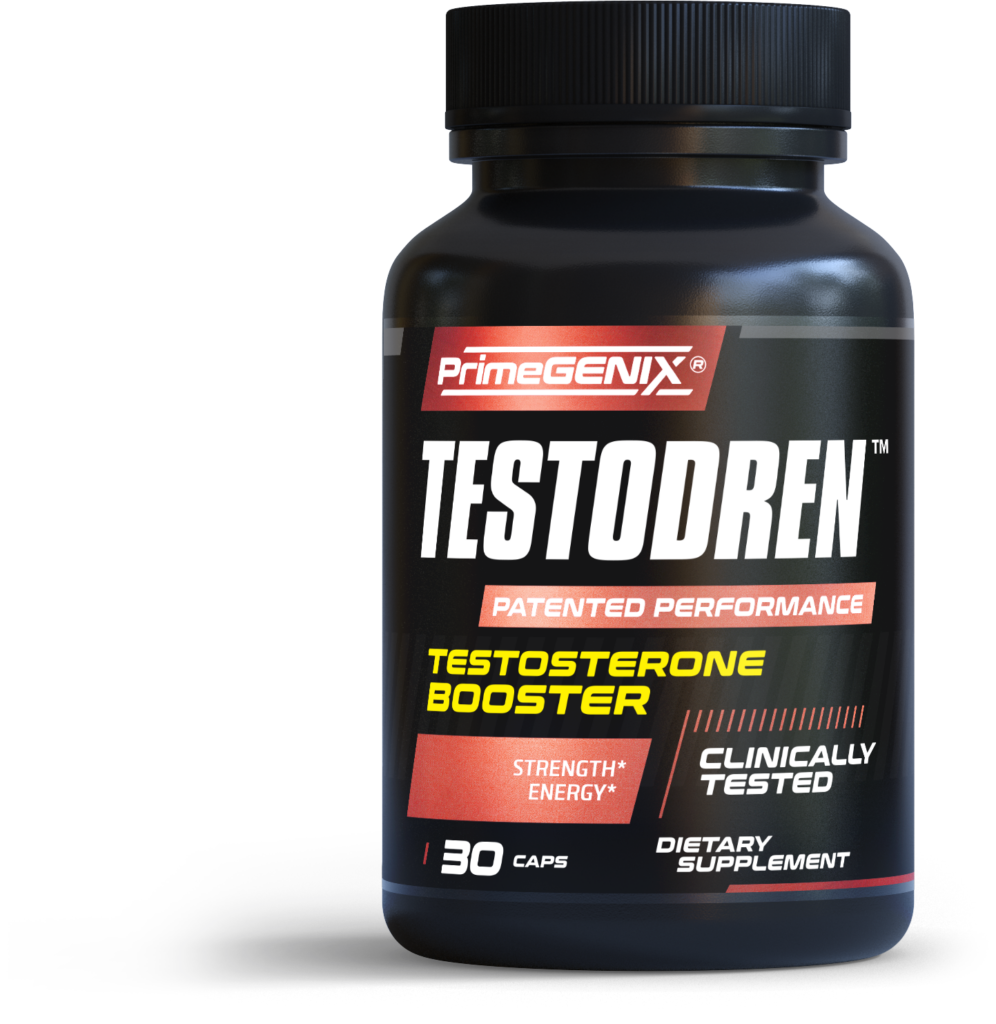
A Related Product: Primegenix Testodren
If the argument above resonates, Testodren is a reasonable place to see it in practice, because the entire product is organizsed around a single twelve week result.
Most testosterone supplements arrive as a long ingredient list inside a proprietary blend, which is a labelling convention that discloses a combined total without telling you how much of anything you are actually getting. Testodren is the opposite shape. It contains one active ingredient, Furosap, a United States patented fenugreek seed extract, at 500mg per capsule. That 500mg is not a round number chosen for the label. It is the exact daily dose used in the published research, which is the only reason the research describes what is in the bottle.⁵ ⁸
The peer reviewed trial followed fifty men aged 35 to 65 over twelve consecutive weeks at that dose. Free testosterone levels improved in 90 percent of the study population, with improvements reported up to 46 percent, alongside changes in sperm profile and reported mental alertness, and no significant adverse changes in lipid profile, blood count, liver or kidney markers.⁵ PrimeGENIX reports a figure of 72.87 percent for the increase in free testosterone from a clinical program in men over 40, across three human trials.⁸ Whichever number you look at, the detail that matters for this article is the same one: the window was twelve weeks. One capsule daily, taken with a meal, for three months. Take it for three weeks and you have not tested it, you have interrupted it.
These statements have not been evaluated by the Food and Drug Administration. This product is not intended to diagnose, treat, cure or prevent any disease. Speak to your doctor before beginning any new supplement, particularly if you take prescription medication or have an existing medical condition.
REFERENCES
1. Shemin D, Rittenberg D. The life span of the human red blood cell. Journal of Biological Chemistry. 1946;166(2):627-636.
2. Pantaleo A, Giribaldi G, Mannu F, Arese P, Turrini F. Naturally occurring anti-band 3 antibodies and red blood cell removal under physiological and pathological conditions. Autoimmunity Reviews. 2008;7(6):457-462.
3. Halprin KM. Epidermal turnover time, a re-examination. British Journal of Dermatology. 1972;86(1):14-19.
4. Weinstein GD, Van Scott EJ. Autoradiographic analysis of turnover times of normal and psoriatic epidermis. Journal of Investigative Dermatology. 1965;45(4):257-262.
5. Maheshwari A, Verma N, Swaroop A, Bagchi M, Preuss HG, Tiwari K, Bagchi D. Efficacy of Furosap, a novel Trigonella foenum-graecum seed extract, in enhancing testosterone level and improving sperm profile in male volunteers. International Journal of Medical Sciences. 2017;14(1):58-66.
6. GenF20 Plus formulation and product information. genf20.com
7. HyperGH 14x formulation and dosing information. hypergh14x.com
8. PrimeGENIX Testodren product and clinical information. primegenix.com