


Your body accumulates damaged “zombie” cells as you age. A natural flavonoid found in strawberries may be one of the most potent tools science has found to remove them.
What Are Senescent Cells — And Why Should You Care?
Every day, billions of your cells divide, repair, and replicate. But with time — and under stress — some cells reach a point where they can no longer function properly. Rather than dying off through a natural process called apoptosis, these cells enter a state called cellular senescence. They stop dividing but refuse to die.
Scientists have taken to calling them “zombie cells.” They linger in your tissues, secreting a toxic cocktail of inflammatory proteins known as the Senescence-Associated Secretory Phenotype (SASP). SASP chemicals damage neighboring healthy cells, fuel chronic inflammation, impair tissue repair, and have been linked to nearly every major age-related decline — from joint stiffness and cognitive fog to cardiovascular disease and reduced immune function.
“The accumulation of senescent cells is now considered one of the primary hallmarks of aging — and clearing them may be one of the most promising strategies for extending healthspan.”
This is where a new class of compounds called senolytics comes in. Senolytics are agents that selectively target and eliminate senescent cells, leaving healthy cells unharmed. Research in this area has exploded over the past decade, and one natural compound keeps rising to the top: fisetin.
What Is Fisetin?
Fisetin is a naturally occurring polyphenolic flavonoid found in a variety of fruits and vegetables — most notably strawberries, apples, mangoes, cucumbers, and onions. It has been studied for its antioxidant, anti-inflammatory, and neuroprotective properties for years, but its most exciting potential lies in its senolytic activity.
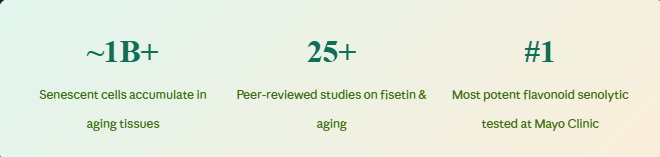
In a landmark 2018 study published in EBioMedicine by researchers at the Mayo Clinic, fisetin outperformed 10 other natural and synthetic compounds in its ability to selectively clear senescent cells. The finding positioned fisetin as the most potent natural senolytic identified at the time — a result that sparked enormous scientific and public interest.
How Fisetin Works as a Senolytic
Senescent cells survive longer than they should partly because they hijack survival pathways that healthy cells also use. Fisetin works through several distinct but complementary mechanisms to specifically push these damaged cells toward programmed death:
BCL-2 pathway inhibition
Fisetin suppresses anti-apoptotic proteins (BCL-2, BCL-XL) that zombie cells use to resist natural cell death.
SASP suppression
It reduces the inflammatory secretions that senescent cells pump into surrounding tissue, calming systemic inflammation.
PI3K/AKT/mTOR modulation
Fisetin interferes with key survival signaling networks that senescent cells exploit, nudging them toward apoptosis.
Oxidative stress reduction
As a potent antioxidant, fisetin neutralizes free radicals that accelerate cellular aging and drive new cells into senescence.
What the Research Says
Animal studies have been striking. In 2018, Mayo Clinic researchers found that intermittent administration of fisetin to aged mice significantly reduced the burden of senescent cells across multiple tissues. Treated mice showed improvements in physical function, healthspan markers, and survival compared to controls — without observable toxicity to healthy cells.
Fisetin has also shown promise for brain health. Studies suggest it crosses the blood-brain barrier, where it may protect neurons, reduce neuroinflammation, and support the signaling pathways involved in memory and learning. Research in mouse models of Alzheimer’s disease has shown that fisetin supplementation preserved cognitive function and reduced amyloid plaque accumulation.
Human clinical trials are underway. The Mayo Clinic and University of Minnesota are conducting Phase 2 trials examining fisetin’s effects in older adults and individuals with conditions linked to senescent cell accumulation. Early signals are encouraging, though this research is still developing.
Beyond senolytics, fisetin has separately demonstrated anti-inflammatory effects comparable to some pharmaceutical agents, potential cancer-preventive properties, and support for healthy blood sugar regulation in preliminary research.
Getting Enough Fisetin From Diet Alone
Strawberries are the richest dietary source, containing roughly 160 mcg of fisetin per gram. But studies on senolytic activity in animals used doses equivalent to many hundreds of milligrams of fisetin in humans — far more than any realistic dietary intake. To consume the fisetin equivalent used in some studies, you would need to eat several pounds of strawberries daily. High-quality supplementation becomes an important consideration for those seeking meaningful senolytic support.
Introducing GenuinePurity® Liposomal Fisetin
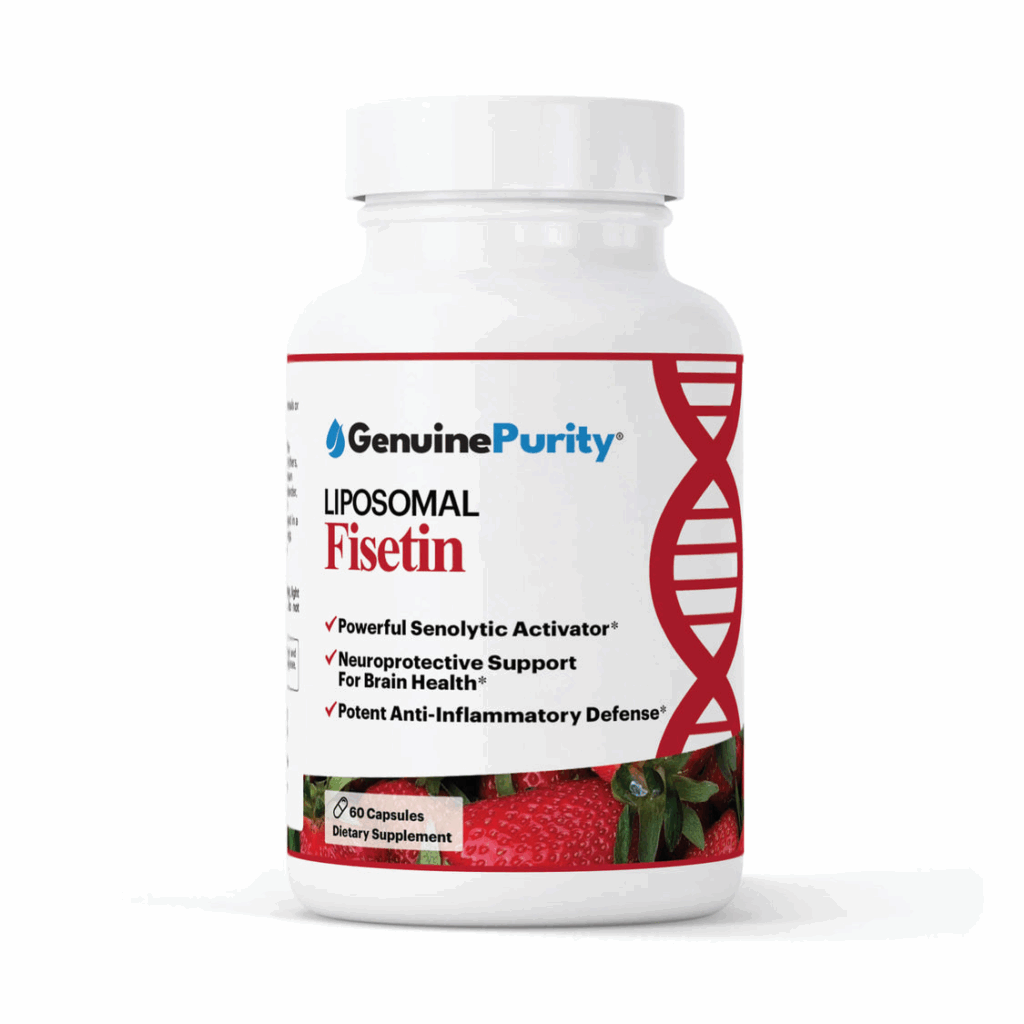
For those looking to incorporate fisetin supplementation into a longevity-focused lifestyle, GenuinePurity® Fisetin is formulated with research-aligned dosing and a commitment to purity and bioavailability.
- 500mg high-potency fisetin per serving — aligned with research dosing protocols
- Enhanced absorption formula for superior bioavailability versus standard fisetin
- Third-party tested — independently verified for purity, potency, and absence of contaminants
- No artificial fillers, binders, or unnecessary additives
- GMP-certified manufacturing facility in the United States
- Suitable for use alongside intermittent senolytic protocols
GenuinePurity® Fisetin is designed for adults who take their cellular health seriously — those who want more than a token dose in a multi-ingredient blend, but a dedicated, high-quality fisetin supplement backed by the science behind it.
Who May Benefit From Fisetin Supplementation?
Fisetin is of greatest interest to individuals who are actively focused on healthy aging and longevity — particularly those over 40, when senescent cell accumulation begins to meaningfully accelerate. It may be of special interest to those experiencing early signs of age-related cognitive or physical decline, individuals with chronic low-grade inflammation, and anyone building a broader longevity stack alongside other evidence-based interventions like NAD+ precursors, quercetin, or lifestyle optimization.
As with any supplement, consulting with a qualified healthcare provider before beginning a new regimen is advisable, particularly for those on medications, as fisetin may interact with certain drugs metabolized by the liver.
The Bottom Line
Senescent cells are no longer just a theoretical concept in aging biology — they are a measurable, targetable driver of age-related decline. Fisetin stands out as one of the most scientifically validated natural senolytics available today. For those looking to take a proactive, science-informed approach to cellular health, a high-quality supplement like GenuinePurity® Liposomal Fisetin offers a meaningful way to support the body’s ability to clear these damaged cells and protect the healthy ones that remain.